


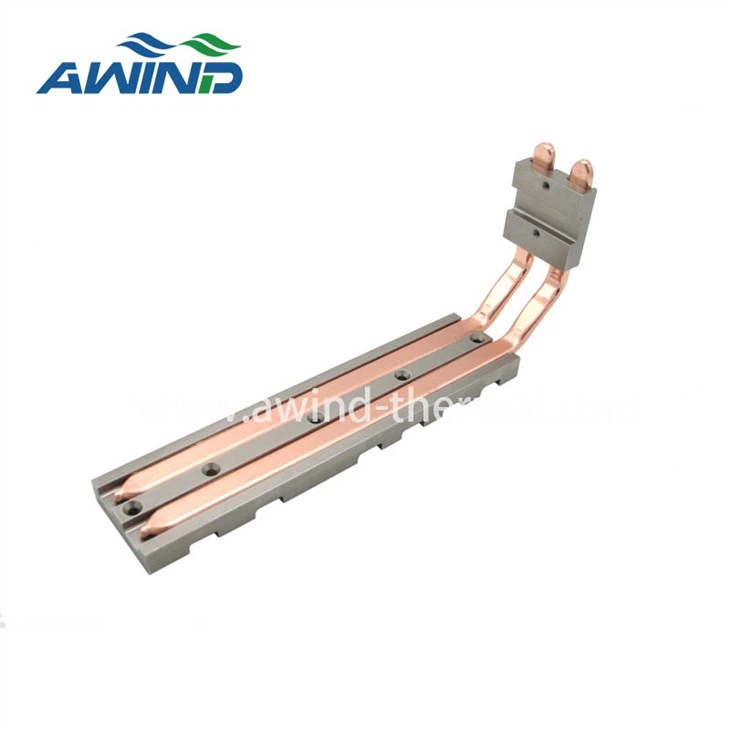

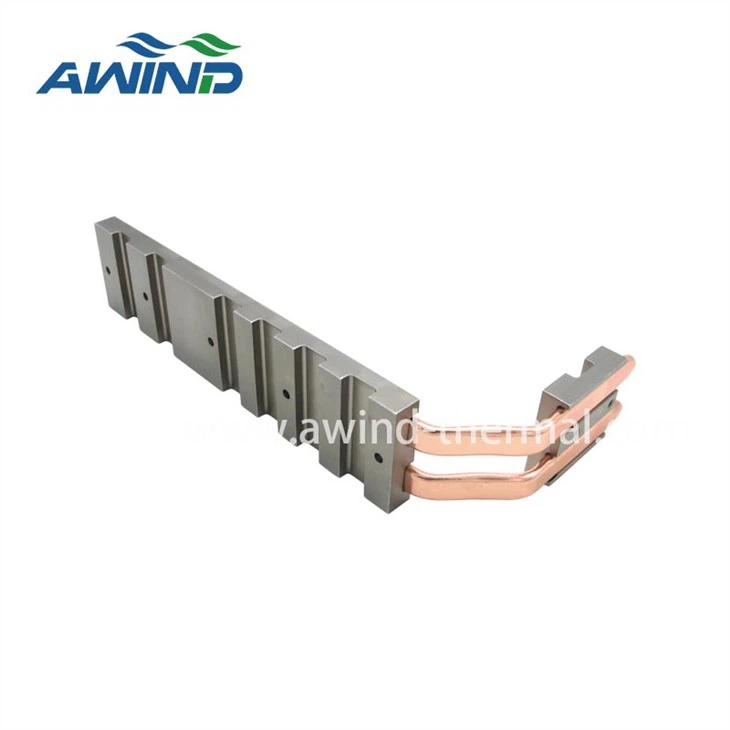
(The product picture is our latest heat sink, welcome to contact us for more)
Heat pipe
Working principle:
The heating end of the heatpipe evaporates the working fluid into a gas, and the gas flows through the hollow pipe to the cooling end. After cooling, the gas condenses into a liquid, which is then sucked back to the heating end by the capillary structure, forming a repeated cycle to complete the suction. Heat-exothermic cycle, so as to achieve the effect of heat transfer.

Different structures of heatpipes:
1. Sintered tube
2. Powder sintering + shallow groove (new sintering)
3. Semi-powder sintering + deep groove (composite pipe)
4. Thin tube
Sintered tube
Sintered tube is made of smooth tube + powder sintering
The sintered tube mainly uses its internal capillary structure and the high thermal conductivity of the working fluid to dissipate heat.

Apparent density:
refers to the mass of the powder per unit volume when the powder is naturally filled into the specified container.
It reflects the particle size of the powder and its irregularity. The smaller the particle size, the more fully filled the powder and the powder, the greater the apparent density; the greater the irregularity, the mutual conflict between the powder and the powder, easy to form an "arch bridge" , the smaller the apparent density.
The greater the apparent density, the greater the amount of powder filling, so now it is basically copper powder with low apparent density.

Schematic diagram of "arch bridge" under microscope
Powder sintering + shallow groove (new sintering)
Due to the high permeability of the groove, the reflow rate of the internal working fluid can be accelerated, and the contact surface between the sintering and the groove will form a contact angle, which also increases the internal capillary force to achieve the purpose of improving performance.
Number of teeth for shallow grooves: D6 80-100 teeth D8 135 teeth


Test method:
T 1 < 75℃
Heating size:20mm×20mm
Heating length:60mm
T ambient = 25 3oC T3=57 ± 3℃
∆T ≦ 5 ℃ (∆T = T2 – T4)


The power of 6mm shallow groove + sintered heat pipe is higher than that of sintered heat pipe
Heat Pipe Length=200mm (φ6)

The Qmax of 100 Grooves Sinter Heat Pipe is higher than sinter pipe.
Heat Pipe Thickness=3.0mm (φ6)
Semi-powder sintering + deep groove (composite pipe)

Comparison of three different tube types

Comparison under the same length, same center rod and horizontal test conditions: composite tube is better than sintered and new sintered, new sintered is better than sintered tube.
Test comparison of different tube types and different angles

A. Grooved Pipe

B. Sintered Tube

C. New sintered tube

D. Composite height = 40mm

E. Composite height = 60mm

F. Composite Height = 80mm

G. Composite height = 100mm

H. Composite height = 140mm

I. Composite height = 170mm

It can be seen that the negative angle power of the composite pipe increases with the increase of the powder filling height, while the horizontal power decreases with the increase of the powder filling height; the best negative angle test is shallow groove + powder sintering.
When designing a partially powder-filled composite pipe, special attention should be paid to the negative angle test.
How thin heat pipes work
When the input heat is in the evaporation section, the working fluid in the capillary structure is heated and evaporated into water vapor and enters the steam channels on both sides, and then enters the condensation section through the steam channel to release latent heat and condense into liquid, and the liquid passes through the capillary force of the middle capillary core. Under the action of backflow to the evaporation section, thus forming a working cycle.

Flexible Heat Pipe Heatsink Control Parameters
Particle size distribution: Generally, the coarser the powder, the higher the porosity, the higher the permeability, the larger the effective capillary radius (the smaller the capillary force), and the effect of the permeability is greater than that of the smaller capillary force, and the overall heat transfer will still increase.
The size of the central rod: The size of the central rod is related to the thickness of the sintered layer and the size of the steam channel. The smaller the steam channel, the smaller the heat transfer amount that can be transmitted.
Powder filling density: Different filling time, different vibration frequency and amplitude of powder filling machine are related to porosity, permeability and the difficulty of pulling out the rod.
Powder filling length: The powder filling length only needs to be considered when making a composite pipe. If the size of the groove is selected correctly, the powder filling length is generally 2/5 of the length of the heat pipe (the premise is that it is horizontal or along gravity).
Sintering temperature and time: 900~1030℃, 9 hr. When the strength of the sintered layer is insufficient, the sintering temperature can be increased or the sintering time can be increased, and the relative porosity will be reduced.
Reduction temperature and time: The reduction and annealing temperature is above 550 ℃, and the oxide layer is removed to increase the hydrophilicity of the capillary structure and eliminate the internal stress of processing.
Filling water volume: Generally speaking, the best filling water volume is 110%~115%, but in some special situations, such as the case where both vertical and horizontal thermal resistance need to be considered, the filling water volume may be 80~90%. The filling amount is the final fine-tuning of the heat pipe design, and the capillary structure is the main factor determining the performance.
Hot Tags: Heatpipe Heatsink, China, suppliers, manufacturers, factory, customized, free sample, made in China, High Quality Cooling Heat Sink, Vapor Chamber, High Quality Heat Sink, OEM Heat Sink, Zipper Fin Heat Sink, Heat Sink with Copper Heat Pipe


