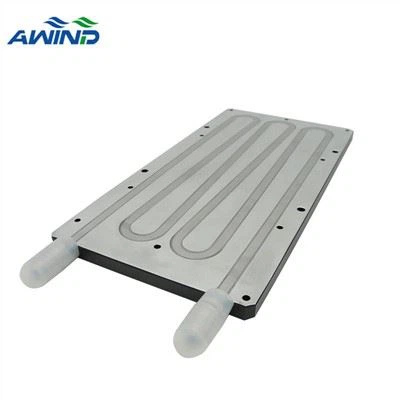
Liquid cooling plate of new energy battery
Liquid cold plate
In the power battery system, the new energy battery work and generates heat, and the heat is transferred through the contact between the battery and the surface of the plate-shaped aluminum device, and is finally taken away by the cooling liquid passing through the internal flow channel of the device. This plate-type aluminum device is a liquid cooled plate.

General requirements for liquid cooling plates
* Large heat dissipation power. The heat generated during the working process of the new energy power battery can be exported in time to avoid the occurrence of excessive temperature rise;
* High reliability. Working in road vehicle environment, vibration, shock, high and low temperature alternating environment, are relatively harsh working conditions for most products, and the power battery voltage is often hundreds of volts, so the coolant leakage is a serious problem, even if you use Coolant with good insulation performance, but after encountering external impurities, the insulation performance will be reduced immediately, therefore, the reliability of water cold plate sealing is very important;
* Precise heat dissipation design. To avoid excessive temperature difference in the system. This is due to the performance requirements of the lithium battery itself. The performance and aging of the battery are closely related to the operating temperature;
* Strict requirements on the weight of the cold plate, which comes from the pursuit of energy density in the power battery system. The cooling system that seriously reduces the energy density of the system is simply unacceptable to both customers and designers.
Liquid cooled plate type:
The types of liquid-cooling plates mainly including: Aluminum Vacuum Brazing Coldplate, Friction Stir-welding Water-cooling Plate (FSW Coldplate), Exposed Tube Water-cooling Plate (Exposed Tube) Coldplate) and other liquid cooling methods. Their respective advantages and disadvantages, please refer to the table below.
| Type | Feature | Disadvantage | Photo |
| Vacuum brazing cold plate | More flexible design structure Better performance (double-sided heat source), High reliability | High requirements for welding High cost |  |
| Friction stir welding cold plate | Flexible design structure, Good performance High reliability | High cost |  |
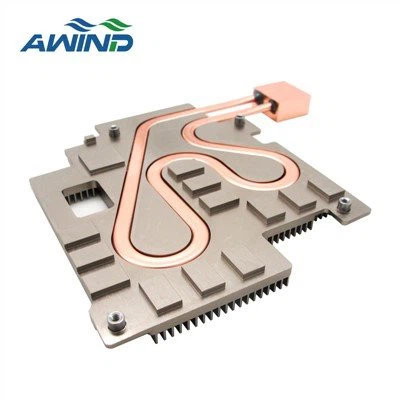
| Exposed copper tube cold plate | High heat dissipation efficiency, Small thermal resistance, Corrosion resistance | The cost is slightly higher, The bending radius of copper tube has a large influence |  |
Liquid cold plate example
Example 1: Emphasis on thermal performance. The fin structure is used in the fluid path to increase the contact area with the cooling liquid, thereby improving the thermal conductivity. Products feature vacuum brazed construction and can be customized.

Example 2: Emphasis on low pressure drop. The liquid cooling plate uses specially fabricated CNC milled micro channels to form fluidic channels on the bottom plate. Under low pressure drop conditions, it has excellent heat dissipation performance, which reduces the cost of the fluid circulation system.

Example 3, emphasizing the structural form of pipeline embedding. The tubes are embedded in the base plate to form a mechanically strong cold plate. Surface-extension liquid cold plates use thicker and denser tubing to increase the area, thereby increasing the surface area in contact with the coolant, thereby improving thermal conductivity.

Hot Tags: Liquid Cold Plate Manufacturer for New Energy Devices, China, suppliers, manufacturers, factory, customized, free sample, made in China, Liquid Cold Plate for Power Supply, Liquid Cold Plate with Copper Tube, Water Cooling Plate with Copper Pipe, Friction Stir Welding Liquid Cold Plate, Heatsink Design, Cooling Plate Heat Sinks