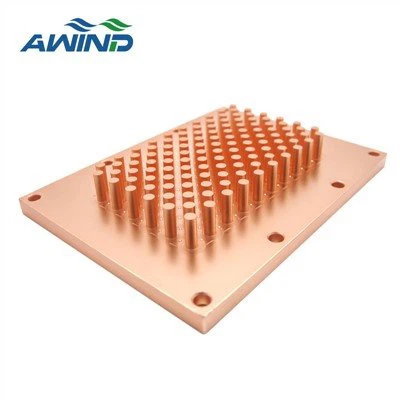
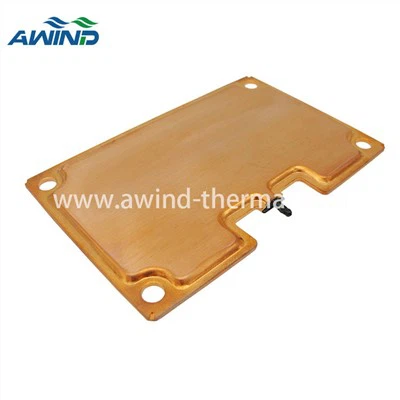
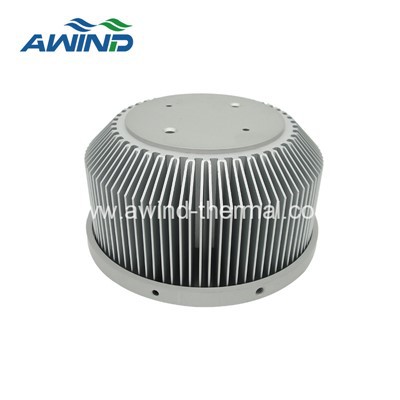
(The product picture is our latest heat sink, welcome to contact us for more)
Heat pipe
Introduction:
The ever-increasing development of science and technology has resulted in higher and higher heat generation density of electronic components, which has an unnegligible impact on performance and reliability.
When the development trend of electronic equipment in the future is going to be light, thin and short, the improvement of its performance and reliability will depend on electronic cooling technology.
According to the relevant statistics of American Aerospace, 55% of the failure of electronic parts mainly comes from the temperature factor.
Therefore, how to deal with the heat dissipation problem has become the key technology of electronic products in recent years, among which the heat pipe also plays a pivotal role.

Heat pipe
Heat pipe is a heat-transfer device that combines the principles of both thermal conductivity and phase transition to effectively transfer heat between two solid interfaces.
Mainly used type of heat pipes, Thermosyphons
Thermosyphons → By Gravitational/accelerational forces → Heat conduction direction is cyclic repetition

The composition of the heat pipe design:
Materials and working fluids:
Envelope Materiel – Copper – Aluminum – Stainless steel
Wick Structure:
Mesh – Fiber – Sinter – Groove
Working fluid:
Water – Methanol – Acetone – Sodium – Mercury...
Principles:
At the hot interface of a heat pipe a liquid in contact with a thermally conductive solid surface turns into a vapor by absorbing heat from that surface.
The vapor then travels along the heat pipe heatsink to the cold interface and condenses back into a liquid – releasing the latent heat.
The liquid then returns to the hot interface through either capillary action, centrifugal force, or gravity, and the cycle repeats.
Working process


Advantages
• Light weight, small size and simple structure
• High thermal conductivity, 100 to 1000 times of thermal performance than copper tube
• Operating temperature range from -243 ℃ to 1000 ℃
• No noise during operation
Thermal test
Delta T test
Ideal temperature difference → 0℃
100% inspection for testing temperature difference → ≦5℃
Purpose - test the Delta T (△T) between the two ends side of heat pipe

Q-max test


Purpose - test the data of Maximum Heat Transfer Rate (Q-max)
Safety test

• Critical components - Heat pipe
• Safety - Pressure vessel
• FAIL TEMPERATURE → 320 ℃ Leakage
• Purpose - Burst tube (Safety test)
| Application purpose | Examples |
| Heat transfer | Heat exchanger, solar water heater, geothermal utilization, heat storage device, air conditione |
| Heating | Boiler, carburetor heating, automatic windshield, heat sealer bath, baking pan, cream knife |
| Cooling | Electronic components such as transistors, diodes, thyristors, ICs, LSIs, VLSIs, CPU and IGBT heat dissipation, machine transformer cooling, rotation, machine cooling, cable cooling, line cooling, mold cooling, refrigerator |
| Others | VCHP, diode, thermal switch, temperature control platform, (biowafer, crystal growth) |
Hot Tags: zipper fins heatsink with heat pipe design, China, suppliers, manufacturers, factory, customized, free sample, made in China, Heat Sink with Copper Heat Pipe, CPU Heat Sink Design, High Quality Heat Sink, Zipper Fin Heat Sink, Vapor Chamber, High Quality Cooling Heat Sink