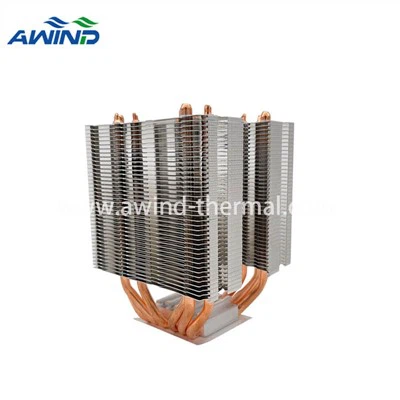
(The product picture is our latest heat sink, welcome to contact us for more)
Hot melt drilling
1. Hot melt drilling process
High-temperature chipless forming and friction hot-melt drilling technology, referred to as hot-melt drilling technology, is a new type of thin plate drilling method. It uses the basic physical principle of frictional heat generation to drill holes with bosses on plate-shaped or tubular metal workpieces, which are formed at one time and without drilling chips. This process completely replaces the process of welding (riveting) nuts on thin-walled workpieces.

2. Development history of hot melt drilling technology
As early as 1923, Mr. VALLIERE, a Frenchman, tried to develop a tool for hot-melt drilling on metal sheets using the principle of frictional heat generation.
After years of experimentation, it was technically successful, but not feasible in practical industrial applications. The reason is that:
a. High-strength cemented carbide has not yet come out;
b. The correct geometry of the drill bit is not known;
c. Diamond grinding wheel has not yet come out;
d. There is no mechanical equipment capable of producing complex special shapes.
It took 60 years for the above problems to be solved and the successful commercialization of hot melt drills.

3. The working principle of the hot melt drilling process
Hot-melt drill is a tool made of special wear-resistant and high-temperature resistant tungsten carbide hard alloy (so it is also called tungsten steel hot-melt drill or cemented carbide hot-melt drill).
When the high-speed rotating drill bit contacts the surface of the workpiece and applies downward axial pressure, the head of the hot-melt drill bit rubs against the metal and generates a high temperature of 650°C to 750°C, which makes the metal in the vicinity of the hot-melt drill bit soften rapidly.
While the hot-melt drill is extruding and penetrating, the softened metal part is stretched into a metal front (boss) with three to four times the original thickness. The whole process only takes 2-6 seconds.
This boss can be used for extrusion tapping, thread forming, which can strengthen the connection effect, and can also be used for bearing support, bifurcated throat connection, etc.

Because the whole process of hot melt drilling process is chip-free processing, the processed thread can withstand high tensile force and torsion force, which can completely replace the previous process of drilling after welding or process of pressing rivet nuts.
4. Hot melt drilling process:
The hot melt drill just touches the material and is positioned, then pressing against the material with high axial force and velocity.

The applied pressure and speed generate frictional heat of about 600°C, which plasticizes and shapes the material. Hot melt drills penetrate materials in seconds.

The hot-melt drill squeezes the metal horizontally and vertically, which moves the material down, creating a bushing. When the hot melt drill penetrates the metal, the feed pressure is gradually reduced, and the feed rate is gradually increased.

Now, the hot melt drilling process has formed a bushing. The material in the opposite direction of the feed is extruded and forms a circular table that can be used for sealing. This circular table can be removed in the same operation by using a flat-type drill with a cutting edge at the position of the drill belt.

Extrusion taps can be used immediately for chip-free tapping of the resulting bushing. Cold extrusion tapping increases material hardness.

Conclusion: Hot melt drills are able to withstand high loads and torsional joints. There is no need for drilling holes, and subsequent down riveting, or welding nuts.

5. Advantages and disadvantages of hot melt drilling
Advantages of hot melt drills:
a. The height of the circular table is more than three times the thickness of the raw material, and can withstand very large torque and tension;
b. High precision and high strength, the drilled holes is high precision.
c. Clean and environmentally friendly, no or very little chips are generated during processing.
d. Fast and efficient, the processing time is only 2~6 seconds.
e. The range of applicable materials is very wide, it's suitable for iron, mild steel, stainless steel, aluminum, copper, titanium, magnetic materials, special alloys and most of the metal materials (except tin or zinc)
f. Can replace expensive processes such as welding and riveting nut.
g. Greatly improve your product quality, save your processing time and reduce your cost.
Disadvantages of hot melt drills:
a. The hot melt drill is only suitable for the processing of thin-walled pipe fittings, and the maximum material thickness of the drilled hole cannot exceed 12.5mm.
b. There must be a space for the flow direction of the hot melt plastic deformation material.
c. The material being processed must be able to withstand high temperatures.
d. Materials that have been sprayed and coated are not suitable for hot-melt drilling processes.
Awind, a factory specializing in manufacturing heatpipe heat sinks, aluminum fin heat sink and water cooling plates, provide you professional thermal design solution and manufacture.
Hot Tags: welding heatpipe aluminum fin heat sink, China, suppliers, manufacturers, factory, customized, free sample, made in China, High Quality Cooling Heat Sink, OEM Heat Sink, Vapor Chamber, CPU Heat Sink Design, Zipper Fin Heat Sink, Heat Sink with Copper Heat Pipe