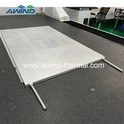
The heat pipe radiator is composed of a sealed tube, a liquid wick and a steam channel. The wick surrounds the tube wall of the sealed tube and is immersed in a saturated liquid that can volatilize. This liquid can be distilled water or ammonia, methanol or acetone. The heat pipe radiator filled with ammonia, methanol, acetone and other liquids still has a good heat dissipation capacity at low temperatures.
When the heat pipe radiator is running, its evaporation section absorbs the heat generated by the heat source (power semiconductor devices, etc.), so that the liquid in the wick is boiled into steam. The steam with heat moves from the evaporation section of the heat pipe radiator to its cooling section. When the steam transfers heat to the cooling section, the steam condenses into liquid. The condensed liquid returns to the evaporation section through the capillary action of the wick on the tube wall, and repeats the above-mentioned circulation process to continuously dissipate heat.