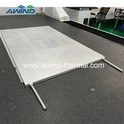
The heat pipe radiator is a high-efficiency radiator device with unique heat dissipation characteristics. That is, it has high thermal conductivity, and the temperature distribution along the axial direction between the evaporation section and the cooling section is uniform and substantially equal.
The thermal resistance of the heat sink is determined by the thermal conductivity of the material and the effective area in the volume. When the volume of a solid aluminum or copper radiator reaches 0.006m³, increasing its volume and area will not significantly reduce the thermal resistance. For discrete semiconductor devices that dissipate heat on both sides, the thermal resistance of an air-cooled all-copper or all-aluminum heat sink can only reach 0.04°C/W. The heat pipe radiator can reach 0.01℃/W. Under the condition of natural convection cooling, the performance of the heat pipe radiator can be improved by more than ten times than that of the physical radiator.