High-Frequency Induction Brazing for Heat Sink Manufacturing
As electronic devices become more powerful and compact, heat sink manufacturers need to do more than simply increase the size of a heat sink. The fin structure, base material, fin density, and the way the fins are joined to the base can all affect the overall thermal management performance.
For some heat sink designs, especially bonded fin and certain copper-aluminum assemblies, brazing provides a reliable way to join separate metal components.
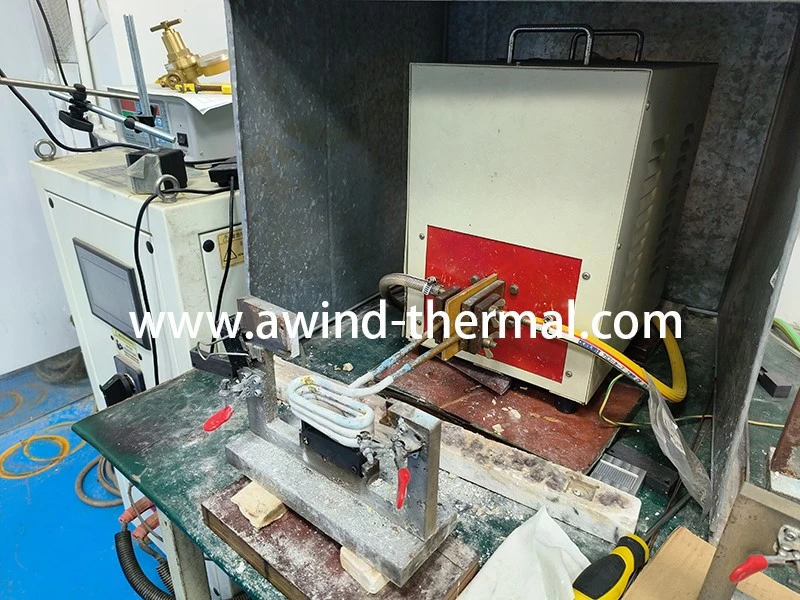
One of the joining methods used for localized heating is high-frequency induction brazing. It uses electromagnetic induction to heat the joint area rapidly and locally, allowing brazing filler metal to form a connection between the components.
For heat sink manufacturing, the value of induction brazing is not simply that it joins two metal parts. The process can also support high-density fin structures, different material combinations, and controlled joining of thin metal components.
What Is High-Frequency Induction Brazing?
High-frequency induction brazing is a metal joining process that uses an alternating electromagnetic field to generate heat in a conductive workpiece.
Unlike conventional flame heating, the heat is generated within the metal by electromagnetic induction. An induction coil is positioned around or near the area to be heated. When high-frequency electrical current passes through the coil, it produces an alternating magnetic field. This field induces electrical currents in the metal, generating heat in the workpiece.
In brazing, the base materials are normally not melted. Instead, the joint is heated to a temperature at which the brazing filler metal melts and flows into the joint. After cooling, the filler metal forms the metallurgical connection between the components.
The basic process can be simplified as:
Induction coil → Electromagnetic field → Localized heating → Filler metal melts → Joint filling → Cooling and solidification
The actual frequency, power, coil design, heating time, joint clearance, and material combination need to be selected according to the specific component.
This is particularly important for heat sinks because many designs use thin fins, narrow gaps, and relatively large fin-to-base ratios.
Why Is Brazing Important in Heat Sink Manufacturing?
A heat sink does not only need a large surface area. Heat must also travel efficiently from the heat source into the heat sink base and then into the fins.
For a bonded fin heat sink, the thermal path can be simplified as:
Heat source → Heat sink base → Brazed joint → Fin → Air
The joint between the fin and the base therefore becomes part of the thermal path.
If separate fins are mechanically assembled but the thermal connection between the fin and the base is poor, the heat transfer path can be affected by the interface.
This is one reason why AWIND uses several joining technologies for bonded fin heat sinks, including thermal epoxy bonding, brazing, and soldering. AWIND's bonded fin assemblies use individually manufactured fins inserted into grooves in an aluminum or copper base.
The appropriate joining method depends on the material, structure, thermal requirements, production volume, and application.
High-Frequency Brazing for Bonded Fin Heat Sinks
A bonded fin heat sink consists of individual fins assembled into a base rather than being formed as one continuous piece of material.
This construction gives designers more flexibility in fin height, thickness, spacing, and material selection.
AWIND's bonded fin heat sinks can use aluminum or copper bases, while the fins can be manufactured from aluminum or copper sheet material. The fins are inserted into machined or extruded grooves and can then be joined by brazing, soldering, or thermal epoxy.
For applications requiring a metal-to-metal connection, brazing can be selected as part of the manufacturing process.
Why Use High-Frequency Induction Brazing for Heat Sinks?
1. Localized Heating
One of the main characteristics of induction heating is that the heating area can be concentrated around the joint.
This is useful when only a specific area of a heat sink needs to be brazed.
For a heat sink with thin fins, unnecessary heating of the entire assembly may increase the risk of distortion or other thermal effects. With a properly designed induction system, the heat input can be concentrated around the required joining area.
The actual heating pattern depends on the frequency, coil geometry, material, component thickness, and process parameters.
2. Fast and Repeatable Heating
Induction heating generates heat directly in the conductive workpiece rather than transferring heat from an external flame or heating element.
This can provide rapid heating of the required area and makes the process suitable for repeated production when the process parameters are properly controlled.
However, heating speed should not be treated as a fixed value for all heat sinks.
A small aluminum fin assembly and a large copper-aluminum heat sink will require different process conditions. Frequency, power, coil design, joint geometry, and heating time must be developed for the specific product.
3. Suitable for Thin Fin Structures
High-performance air-cooled heat sinks often use thin and closely spaced fins to increase the available heat transfer area within a limited footprint.
AWIND's bonded fin heat sink designs can use fin thicknesses from 0.2 to 2.0 mm, with a minimum listed fin pitch of 0.5 mm.
For these structures, the joining process needs to provide sufficient connection while minimizing unnecessary thermal exposure to the surrounding structure.
This is where a localized heating process can become useful.
4. Supports Different Material Combinations
Heat sinks may use aluminum, copper, or a combination of both.
Aluminum is widely used because of its relatively low density and good thermal conductivity, while copper offers higher thermal conductivity and can be useful in areas where heat spreading is important.
AWIND manufactures bonded fin heat sinks using aluminum and copper combinations, including copper fins assembled with aluminum bases.
When different metals are joined, however, the process becomes more demanding. The material combination, surface condition, filler metal, joint clearance, temperature, and heating cycle all need to be considered.
Therefore, high-frequency induction brazing should not be viewed as a universal solution for every copper-aluminum heat sink. It is a manufacturing option that needs to be matched to the specific design.
High-Frequency Brazing and Zipper Fin Heat Sinks
Another heat sink structure closely related to high-density fin manufacturing is the zipper fin heat sink.
Unlike a bonded fin heat sink, a zipper fin stack is manufactured from individual sheet-metal fins that are stamped, folded, and mechanically interlocked.
AWIND's zipper fin process uses specially designed stamped fins with interlocking features to form a dense and parallel fin structure. The fins can be manufactured from materials such as AL 1100, AL 1050, and Copper 1100.
The zipper structure also creates a relatively wider connection area at the bottom of the fins. This helps provide a practical interface between the fin assembly and the heat-absorbing base.
Depending on the material and final assembly design, the fin stack may then require an additional joining process such as brazing.
A Typical High-Frequency Brazing Process for a Heat Sink
The exact manufacturing process depends on the heat sink design, but a typical process can include the following steps.
Step 1: Prepare the Components
The base and fins are manufactured according to the required dimensions and material specifications.
For bonded fin heat sinks, the base may be machined or extruded, while the fins can be stamped from aluminum or copper sheet.
Step 2: Assemble the Fins
The fins are positioned in the grooves or designed joining area of the heat sink base.
The assembly must maintain the required fin spacing, alignment, and joint clearance.
Step 3: Apply the Brazing Filler Metal
The appropriate brazing filler metal is positioned at the joint according to the selected brazing method and material combination.
The filler metal must be compatible with the base materials and the required joint characteristics.
Step 4: Induction Heating
The assembly is positioned relative to the induction coil.
High-frequency electrical energy generates an electromagnetic field, which induces heating in the metal around the joint.
The process parameters are controlled according to the specific heat sink design.
Step 5: Brazing and Cooling
When the required brazing temperature is reached, the filler metal melts and flows into the joint.
After the heating cycle, the assembly is allowed to cool under controlled conditions.
Step 6: Inspection
The finished heat sink can then be inspected for fin alignment, appearance, dimensional accuracy, joint quality, and other customer-specific requirements.
For production parts, the inspection method should be selected according to the product design and quality requirements rather than applying the same inspection procedure to every heat sink.
[Insert Your Actual Process Photos Here]
I recommend putting 3–4 real photos in sequence here:
Fin Preparation → Assembly → High-Frequency Brazing → Finished Heat Sink
This will be much stronger than adding another 500 words of explanation.
High-Frequency Brazing vs. Other Heat Sink Joining Methods
There is no single joining process that is suitable for every heat sink.
AWIND works with different heat sink manufacturing technologies, including bonded fins, zipper fins, skived fins, folded fins, extrusion, heat pipes, and other thermal management structures.
The joining method should therefore be selected according to the product rather than the process itself.
| Joining Method | Typical Consideration |
|---|---|
| High-frequency induction brazing | Localized heating and controlled joining of suitable metal assemblies |
| Vacuum brazing | Suitable for assemblies requiring controlled atmosphere and complex internal or large-area joints |
| Soldering | Useful for certain fin, heat pipe, and metal assembly applications |
| Thermal epoxy | Useful when electrical isolation, lower-temperature assembly, or specific structural requirements are needed |
| Mechanical joining | Can be suitable where thermal interface requirements and mechanical design allow |
The important question is not simply "Which process is the strongest?"
It is:
Which joining process provides the required thermal, mechanical, dimensional, and production performance for this particular heat sink?
When Should You Consider High-Frequency Brazing for a Heat Sink?
High-frequency induction brazing may be worth considering when a heat sink requires:
Separate fins joined to a metal base
Localized heating around a specific joint
Thin or high-density fin structures
Copper, aluminum, or selected dissimilar-metal assemblies
Repeatable production processes
A metal-to-metal joining method rather than adhesive bonding
However, the final process should be confirmed through engineering evaluation and sample testing.
The right choice depends on the heat load, base and fin materials, fin geometry, required thermal resistance, dimensional constraints, production volume, and joining requirements.
AWIND Heat Sink Manufacturing
AWIND is a thermal management manufacturer with more than 20 years of experience in heat dissipation solutions and custom manufacturing.
Our heat sink capabilities include bonded fin heat sinks, zipper fin heat sinks, skived fin heat sinks, folded fin heat sinks, aluminum extrusion heat sinks, heat pipe heat sinks, vapor chamber solutions, and liquid cooling plates.
For bonded fin heat sinks, AWIND can work with aluminum and copper materials and different joining technologies, including brazing, soldering, and thermal epoxy bonding.
Rather than selecting a manufacturing process first, we can evaluate the heat sink structure, material combination, thermal requirements, and available installation space to determine a suitable manufacturing route.
If you are developing a custom bonded fin heat sink, zipper fin heat sink, or copper-aluminum heat sink, you can provide us with your thermal requirements, drawings, dimensions, or existing sample. Our engineering team can help evaluate the structure and manufacturing process.
Contact AWIND for a custom heat sink solution.