The Ultimate Guide to Heat Pipe Heat Sinks: Working Principle, Types, and Selection
Introduction
In today's world of high-power electronics-from servers and inverters to LED lighting and electric vehicles-managing heat is critical to performance and reliability. Statistics show that over 55% of electronic failures are temperature-related . As devices become smaller and more powerful, traditional cooling methods often fall short. Enter the heat pipe heat sink: a passive, highly efficient thermal management solution that combines the principles of phase-change heat transfer with advanced fin designs.
This comprehensive guide will walk you through everything you need to know about heat pipe heat sinks: how they work, their key components, different types, performance testing, and how to select the right one for your application. We'll also compare heat pipes with vapor chamber technology to help you make informed engineering decisions.
What Is a Heat Pipe?
Before diving into heat pipe heat sinks, it's essential to understand the fundamental question: what is a heat pipe?
A heat pipe is a heat-transfer device that combines the principles of both thermal conductivity and phase transition to efficiently transfer heat between two solid interfaces . First patented by R.S. Gaugler of General Motors in 1942 and later independently developed by George Grover at Los Alamos National Laboratory in 1963, heat pipes have become indispensable in modern electronics cooling .
The beauty of a heat pipe lies in its simplicity: it contains no moving parts, requires no external power, and can transfer heat hundreds of times more effectively than a solid copper rod of the same dimensions .

How Do Heat Pipes Work?
Understanding how do heat pipes work is crucial for anyone involved in thermal management. The operation relies on a continuous evaporation-condensation cycle:
The Four-Step Cycle
Evaporation: At the hot interface (evaporator section), a liquid in contact with a thermally conductive solid surface turns into vapor by absorbing heat from that surface .
Vapor Flow: The vapor then travels along the heat pipe to the cold interface (condenser section), driven by the pressure gradient created during evaporation .
Condensation: The vapor condenses back into liquid at the cooler end, releasing the latent heat of vaporization .
Return Flow: The liquid returns to the hot interface through capillary action (via a wick structure), centrifugal force, or gravity, and the cycle repeats .
This phase-change mechanism results in an effective thermal conductivity 100 to 1000 times higher than that of solid copper, enabling heat to be transported over distances with minimal temperature drop .

Heat Pipe Structure and Components
A typical heat pipe consists of three main parts :
1. Envelope
The sealed pipe that contains the working fluid. Common materials include:
Copper: Most common for electronics cooling, excellent thermal conductivity
Aluminum: Lightweight, used with ammonia working fluid for spacecraft
Stainless steel: For high-temperature or corrosive environments
2. Wick Structure
The porous lining inside the tube that uses capillary action to return condensed liquid. Common wick types include :
| Wick Type | Pore Radius | Permeability | Best Orientation |
|---|---|---|---|
| Grooved | Large | High | Horizontal or gravity-aided |
| Screen Mesh | Medium | Medium | Moderate orientation flexibility |
| Sintered Powder | Small | Low | Any orientation (including anti-gravity) |
| Composite | Variable | Variable |
Hybrid applications |

Sintered tube

Powder sintering + shallow groove
3. Working Fluid
The fluid is chosen based on the operating temperature range :
| Fluid | Temperature Range | Typical Applications |
|---|---|---|
| Water | 30–200°C | Most electronics cooling |
| Ammonia | -60–100°C | Spacecraft thermal control |
| Methanol | 10–130°C | Low-temperature electronics |
| Acetone | 0–120°C | Consumer electronics |
| Sodium | 600–1100°C | High-temperature industrial |
Heat Pipe Heat Sink: Complete Assembly
A heat pipe heat sink integrates one or more heat pipes into a finned structure (usually aluminum or copper) to create a complete cooling solution. The heat pipes act as super-thermal conductors, moving heat rapidly from the base to the fins, where it is dissipated by convection (with or without a fan).
Manufacturing Process
Heat Pipe Fabrication: The tube is filled with working fluid, evacuated, and sealed .
Fin Attachment: Fins are attached to the heat pipes using methods such as:
Soldering/Brazing: Provides strong metallurgical bond with low thermal resistance
Zipper Fins (Skived/Folded): Stamped and folded fins slid over pipes for high fin density
Embedded/Press Fit: Heat pipes pressed into grooved base plate
Types of Heat Pipe Structures
Here are the main types of heat pipe constructions:
1. Sintered Heat Pipe
Manufacturing: Copper powder is sintered onto the inner wall
Apparent Density: Reflects powder particle size and irregularity; lower apparent density powder helps prevent "arch bridge" formation during filling
Advantages: Strong capillary force, works in any orientation (including anti-gravity)
Typical Use: CPU coolers, high-power electronics
2. Grooved Heat Pipe
Manufacturing: Shallow or deep grooves are extruded or machined inside the tube
Advantages: High permeability, low resistance to liquid flow
Number of Teeth: D6: 80-100 teeth, D8: 135 teeth
Typical Use: Horizontal or gravity-assisted applications
3. Composite Heat Pipe (Sintered + Grooved)
Manufacturing: Combines grooves for liquid flow with sintered layer for additional capillary force
Advantages: Higher Q-max than pure sintered pipes, excellent anti-gravity performance
Design Consideration: When partially powder-filled, negative angle testing requires special attention
Typical Use: Demanding applications requiring both horizontal and anti-gravity performance
4. Thin/Flexible Heat Pipe
Working Principle: When heat is input at evaporation section, working fluid vaporizes and enters steam channels, then condenses and returns via capillary force
Control Parameters:
Particle size distribution: Coarser powder = higher porosity, higher permeability
Central rod size: Affects sintered layer thickness and steam channel size
Powder filling density: Related to filling machine vibration frequency
Sintering temperature: 900~1030℃ for approximately 9 hours

Vapor Chamber vs Heat Pipe: Which Is Better?
A common question in thermal management is vapor chamber vs heat pipe-which technology should you choose? Both operate on the same phase-change principle, but they differ in geometry and application .
Key Differences
| Feature | Heat Pipe | Vapor Chamber |
|---|---|---|
| Heat Spreading | Linear (along pipe axis) | 2D planar distribution |
| Thickness Profile | 3–6mm typical | As thin as 0.3mm |
| Response to Hotspots | Moderate-depends on pipe placement | Excellent-immediate diffusion |
| Cost | Lower (mature manufacturing) | Higher (precision sealing required) |
| Best Use Case | Laptops, desktops, larger devices | Smartphones, ultrabooks, thin devices |

vapor chamber
Performance Comparison
Vapor chambers generally offer 20–30% better thermal conductivity than equivalent heat pipe setups in constrained spaces . However, heat pipes excel when you need to move heat over longer distances (e.g., from GPU near motherboard edge to rear exhaust fins) .
When to Choose Each
Choose heat pipes when :
You need to transport heat over distances >100mm
There's room for larger fin stacks and multiple fans
Cost control is a priority
The device may experience physical stress (heat pipes are more mechanically resilient)
Choose vapor chambers when :
Space is extremely limited (thin devices)
You need to spread heat over a large area quickly
You're dealing with high heat flux density hotspots
The application can justify higher cost

Heat Pipe Performance Parameters and Testing
To ensure quality, heat pipes undergo rigorous testing :
1. Heat Transport Limitations
There are five primary heat transport limitations that determine maximum heat pipe capacity :
| Limit | Description | Cause |
|---|---|---|
| Viscous | Viscous forces prevent vapor flow | Operating below recommended temperature |
| Sonic | Vapor reaches sonic velocity at evaporator exit | Too much power at low operating temperature |
| Entrainment | High-velocity vapor prevents condensate return | Operating above designed power input |
| Capillary | Pressure drops exceed capillary pumping head | Input power exceeds design capacity |
| Boiling | Film boiling in evaporator | High radial heat flux |
The capillary limit is usually the limiting factor in heat pipe design, and it's strongly influenced by operating orientation and wick structure .
2. Delta T (ΔT) Test
Measures temperature difference between evaporator and condenser ends. A smaller ΔT indicates better isothermal performance. Industry standard: 100% inspection with ΔT ≤ 5℃.
3. Q-max Test
Determines the maximum heat transport capacity (in watts) before the wick dries out. This depends on wick structure, fluid, and orientation.
4. Safety/Burst Test
Heat pipes are pressure vessels tested to withstand high temperatures without leaking. Typical fail temperature: 320℃ for leakage.
5. Thermal Resistance Calculation
For a copper/water heat pipe with powder metal wick, approximate thermal resistance guidelines :
Evaporator/Condenser: 0.2°C/W/cm² (based on outer surface area)
Axial: 0.02°C/W/cm² (based on vapor space cross-sectional area)
Example: For a 1.27cm diameter, 30.5cm long heat pipe dissipating 75W with 5cm evaporator and condenser lengths, the calculated ΔT ≈ 3.4°C .
Advantages of Heat Pipe Heat Sinks
Ultra-High Thermal Conductivity: Transfers heat 100–1000 times better than solid copper
Isothermal Operation: Temperature difference between evaporator and condenser very small
Lightweight and Compact: Enables slim designs for modern electronics
No Moving Parts: Silent operation and high reliability
Wide Operating Range: From cryogenic (-243°C) to high-temperature (1000°C) applications
Passive Operation: No external power required
Common Materials: Brass vs. Purple Copper
Understanding material differences is crucial for heat sink design:
Purple Copper (C1100)
Purity: >99.9% pure copper
Thermal Conductivity: Excellent
Applications: Heat pipes, water cooling plate pipelines
Characteristics: Better conductivity and thermal transfer than brass
Brass (Copper-Zinc Alloy)
Composition: Copper + zinc (copper content typically 60-80%)
Properties: Higher hardness, good ductility, better corrosion resistance
Applications: Structural components, water cooling plate joints
Characteristics: Good oxidation resistance, lower thermal conductivity than pure copper
Embedded Copper Tube Cold Plate
Combines both materials to leverage their advantages: purple copper for rapid heat conduction, brass for corrosion resistance and structural stability .
Design Considerations and Selection Guide
Step 1: Define Requirements
Heat Load (Q): How many watts need to be dissipated?
Maximum Allowable Temperature: Tjunction or Tcase
Ambient Conditions: Airflow, temperature, space constraints
Orientation: Will heat pipes operate horizontally, vertically, or against gravity?
Step 2: Select Wick Type Based on Orientation
| Orientation | Recommended Wick | Reason |
|---|---|---|
| Gravity-assisted (condenser above evaporator) | Grooved or mesh | Large pore radius, high permeability |
| Horizontal | Sintered or composite | Balanced capillary force |
| Anti-gravity (evaporator above condenser) | Sintered only | Small pore radius, strong capillary force |
Step 3: Determine Heat Pipe Size and Quantity
Diameter: Common sizes 4mm, 6mm, 8mm. Larger diameters transport more heat but require more space
Number of Pipes: Multiple heat pipes used in parallel to spread heat and reduce thermal resistance
Step 4: Fin Design
Fin Material: Aluminum (lightweight, cost-effective) or copper (higher conductivity)
Fin Density: More fins increase surface area but may restrict airflow
Attachment Method: Soldered joints offer best thermal performance
Applications Across Industries
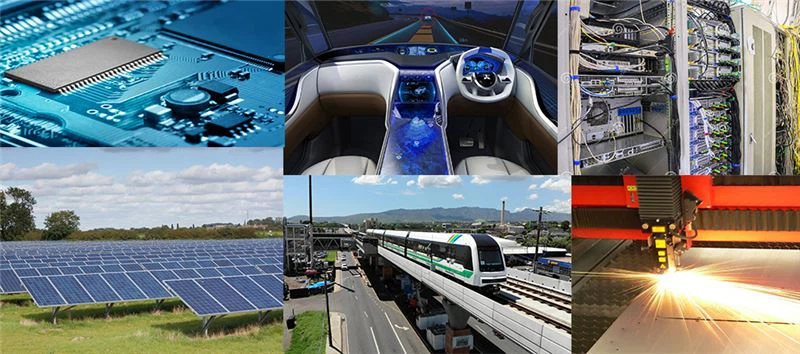
Heat pipe heat sinks are used in diverse applications:
| Application Area | Examples |
|---|---|
| Power Electronics | Inverters, IGBTs, thyristors, UPS systems |
| Computing | CPUs, GPUs, servers, high-end laptops |
| Telecommunications | Base stations, communication equipment |
| LED Lighting | COB LEDs, high-brightness modules |
| Renewable Energy | Wind power converters, solar inverters |
| Medical Equipment | Lasers, imaging devices |
| Industrial | Motor drives, welding equipment |
| Aerospace | Satellite thermal control |
Frequently Asked Questions
Q: Do heat pipes ever leak or fail?
High-quality heat pipes are sealed and tested for burst pressure tolerance. They have very long lifespans but can fail if punctured or operated beyond Q-max limits.
Q: Can heat pipes be bent?
Yes, but careful bending is required to avoid kinking that restricts vapor flow. Minimum bend radius guidelines must be followed.
Q: How do I calculate how many heat pipes I need?
This depends on total heat load and each pipe's Q-max. Thermal simulation (CFD) is recommended for complex designs.
Q: Is a black heat sink better?
No-while black surfaces radiate slightly better, convection is the dominant cooling mechanism for finned heat sinks. Color has negligible effect on performance.
Q: Why not make the whole heatsink from copper?
Copper is heavy, expensive, and harder to machine. Combining copper heat pipes with aluminum fins offers excellent balance of performance, weight, and cost.
Q: What's the difference between heat pipes and vapor chambers?
Heat pipes transfer heat linearly (1D), while vapor chambers spread heat across a surface (2D). Vapor chambers are better for thin devices with high heat flux density .
Q: Can heat pipes work in any orientation?
Sintered wick heat pipes work in any orientation due to strong capillary forces. Grooved wick heat pipes require gravity assistance .


Conclusion
Heat pipe heat sinks are indispensable for modern high-power electronics. By leveraging phase-change technology, they deliver exceptional thermal performance in compact, reliable packages. Whether you need a standard design or fully customized solution, understanding the fundamentals-wick types, materials, testing, and selection criteria-will help you achieve optimal cooling.
For applications requiring ultra-thin profiles or handling extreme heat flux density, vapor chamber cooling may be the superior choice . However, for most electronics cooling applications requiring heat transport over distance, heat pipe heat sinks remain the most cost-effective and reliable solution.
Ready to discuss your project? Contact us for a free thermal consultation or to request a quote. Our engineers are here to help you find the perfect cooling solution.