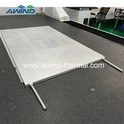
Inside a High-Performance Copper Cold Plate: Why Flow Path Design Matters
However, material selection is only part of the thermal solution.
Even with excellent thermal conductivity, cooling performance ultimately depends on how effectively the coolant removes heat from the cold plate. This is where internal flow channel design becomes critical.
Our copper cold plate uses a single inlet and a single outlet, but internally the coolant follows a carefully designed three-stage flow path that combines folded fins and lanced offset fins to maximize heat transfer while maintaining good temperature uniformity.


The Flow Path Inside the Cold Plate
The coolant travels through the following sequence:
Inlet → Folded Fin Section → Offset Fin Section → Second Folded Fin Section → Outlet
Instead of flowing through a simple straight channel, the coolant experiences different flow conditions in each section.
The first folded-fin region provides a large heat transfer area with relatively low flow resistance.
The coolant then enters the offset-fin region, where turbulence is intentionally increased to improve local heat transfer.
Finally, the coolant passes through a second folded-fin section before exiting the cold plate, allowing any remaining cooling capacity to be fully utilized.
This staged approach helps achieve both low thermal resistance and improved temperature distribution across the cooling surface.

Why We Use a Center Inlet Design
Many conventional cold plates introduce coolant from one end and discharge it from the opposite end.
While simple, this arrangement often creates temperature differences across the cooling surface. Components located near the inlet receive colder coolant, while downstream components are cooled by warmer fluid.
In high-power inverter applications, this temperature difference can become significant.
To address this issue, the inlet of our cold plate is positioned directly above the center folded-fin section.
When coolant enters the plate, it naturally divides and flows toward both sides.
Since power semiconductor devices are often located near the center of the cold plate, the coldest coolant reaches the highest heat flux area first. This helps improve temperature uniformity and reduces thermal gradients across the cooling surface.
For inverter systems, lower temperature differences can contribute to more stable device operation and longer service life.
Offset Fins: Higher Flow Resistance for Stronger Heat Transfer
The lanced offset-fin section is located in the area where heat concentration is highest.
Compared with folded fins, offset fins have a much denser structure. The fins are arranged in a staggered pattern, creating numerous narrow passages that continuously disturb the coolant flow.
As the coolant moves through this region, it is forced to repeatedly change direction.
This increases turbulence and continuously breaks up the thermal boundary layer that naturally forms along solid surfaces.
The result is a significantly higher convective heat transfer coefficient compared with a simple straight channel.
The trade-off is increased pressure drop.
However, for applications where cooling performance is the primary goal, this additional flow resistance is often worthwhile because it allows a much larger amount of heat to be removed from the hottest area of the cold plate.

Why Add a Second Folded-Fin Section?
In some cold plate designs, coolant exits immediately after passing through the high-performance fin region.
We chose a different approach.
Although the coolant temperature rises after flowing through the offset-fin section, it still retains additional heat absorption capacity.
By adding a second folded-fin section before the outlet, the coolant continues exchanging heat with the cold plate rather than leaving unused cooling potential behind.
Folded fins provide a large effective surface area compared with a smooth channel wall, allowing residual heat to be captured before the coolant exits the system.
This helps maximize the overall thermal performance of the cold plate.
A Small Detail That Matters: Fin Retention Features
Folded fins are manufactured from thin copper material.
During long-term operation, coolant flow can create vibration or movement if the fins are not adequately secured.
To maintain structural stability, retaining features are integrated on both sides of the folded-fin sections.
These features lock the fins in position without blocking the primary flow path.
Although this detail is rarely visible from the outside, it helps ensure consistent thermal performance and manufacturing reliability across production batches.

Conclusion
The performance of a liquid cooling cold plate is determined by more than just material selection.
By combining a center inlet design, folded fins, offset fins, and a staged flow path, this copper cold plate achieves improved heat transfer, better temperature uniformity, and efficient utilization of coolant capacity.
The internal structure is only one part of the overall solution, however.
Even the best flow channel design cannot deliver its full performance if the contact surface between the cold plate and the heat source is not properly machined.
In the next article, we will look at machining accuracy and reliability testing, including flatness control, surface finishing, and 6-bar pressure testing used to verify long-term sealing performance in inverter and new energy applications.