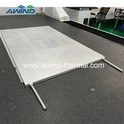
Why choose aluminum as heat sink material? At present, the commonly material for
heat sinks on the market is aluminum alloy. In fact, aluminum is not the metal with the best thermal conductivity, silver is the best, followed by copper, and then aluminum. However, silver is too expensive to be used as heat sink; although copper is bulky, it has advantages in heat dissipation effect and price, and now gradually used as heat sink; aluminum has both thermal conductivity and light weight. Therefore, It is generally used as the best material for heat sink of electronic parts. Aluminum heat sinks are not 100% pure aluminum, because pure aluminum is too soft, so small amount of other metals are added and cast into aluminum alloys to obtain appropriate hardness, but aluminum still accounts for about 98%.
From the comprehensive consideration of cost and heat dissipation capacity, we often use aluminum alloy as heat sink material.
"Need an aluminum heat sink or cold plate for your project? Our engineers help you select the right material and process – free of charge. [Contact us →]" Pure alumin and Aluminum alloy(Pictures from the Internet)
Aluminum alloy's advantageThe thermal conductivity indicates the thermal conductivity of the metal. The larger the thermal conductivity, the lower the thermal conductivity and the greater the thermal conductivity. Among metal materials, silver has the highest thermal conductivity, but the cost is high; pure copper is the second, but it is not easy to process. 6063 T5 aluminum alloy is generally used in air-cooled heatsink because of its good workability, easy surface treatment and low cost.
Because of these characteristics of aluminum, we offer a variety of aluminum heat dissipation solutions:Aluminum extrusion heat sink→ [View product]Vacuum brazed water-cooled plate → [View product]Copper tube embedded in aluminum cold plate → [View product]
| Material | Thermal Conductivity |
| 99.9% Silver | 411 W/m.K |
| Pure Copper | 398 |
| Pure Aluminum | 237 |
| 6061 Aluminum Alloy | 155 |
| 6063 Aluminum Alloy | 201 |
The selection of aluminum radiators needs to consider: power density, space limitations, airflow or liquid cooling conditions. If you are unsure which process is most suitable for your project, please contact us

Copper base with aluminum fins