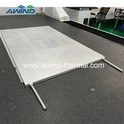
As electronic devices continue to evolve with higher power densities, the demand for superior thermal performance and structural integrity in heat sinks has never been greater. In this context, welding technology plays a pivotal role. Among advanced joining methods, laser welding is emerging as a critical solution for high-performance heat sink and cold plate manufacturing. This article explains what laser welding is and why it is increasingly adopted for creating more reliable and efficient thermal management products.
1. What is Laser Welding?
Laser welding is a high-precision joining process that utilizes a focused, high-energy-density laser beam as a heat source. The concentrated energy allows for localized melting and fusion of materials within milliseconds, resulting in a strong, clean weld. Key characteristics include minimal heat input, a narrow heat-affected zone (HAZ), and exceptional accuracy.

2. Why Choose Laser Welding for Heat Sinks?
We integrate laser welding into the manufacturing of specific heat sink and cold plate designs, particularly where dimensional precision and weld quality are non-negotiable. Here are the primary reasons driving this choice:
Unmatched Precision and Consistency
Laser welding is controlled via automated programs that dictate the welding path, power, and speed with pinpoint accuracy. Combined with custom fixtures, this ensures high repeatability and consistent weld quality-ideal for volume production of critical components.
Minimal Thermal Distortion
The highly concentrated energy input significantly reduces the overall heat exposure to the workpiece. This leads to low thermal distortion, preserving the flatness and structural integrity of the heat sink, which is crucial for maintaining optimal contact and performance in high-power applications.
A Flux-Free and Filler-Free Process (Key Advantage)
Perhaps the most significant benefit for thermal systems is the ability to perform autogenous welding-melting the base materials without adding solder or filler wire. This eliminates the risks of flux residue, solder spatter, or internal contamination.
Why this matters for cold plates: Internal coolant channels are susceptible to blockage or corrosion from any foreign particles. Laser welding ensures a clean, unobstructed fluid path, directly enhancing long-term system reliability and cooling efficiency.

(The area marked with a blue box is the welding area formed using the laser welding process)
3. Conclusion: Precision for the Sake of Reliability
While laser welding presents specific requirements in terms of equipment, tooling, and parameter optimization, it offers substantial benefits in weld quality, reliability, and consistency for suitable applications.
At Awind, our choice to employ processes like laser welding stems from a fundamental commitment to long-term product reliability. This pursuit of precision permeates every stage of our work-from thermal design simulation and material selection to advanced manufacturing and rigorous testing. We are dedicated to providing comprehensive thermal management solutions that are trustworthy, from the inside out.