


If you have been following data centers or electric vehicles recently, you are likely to hear the term 'liquid cooling'. Simply put, liquid cooling is the use of liquid instead of air to remove heat. It may sound like just a change in medium, but in practical engineering, the impact of this transformation is enormous.
For example, the power consumption of an AI server may be 5 to 10 times that of a regular server in the past. If traditional fans are used for blowing, not only is the noise loud, but it is also difficult to remove heat in a timely manner, resulting in equipment frequency reduction, shortened lifespan, and even downtime. Liquid cooling is different. The thermal conductivity of water is dozens of times that of air, and the same volume can carry away much more heat.
That's why more and more people are seriously considering liquid cooling solutions, from large data centers to electric vehicle battery packs.
Is the air cooling not enough? The key is to consider power density
It's not that air cooling is completely useless. When the power density of the cabinet is not high, air cooling is actually cheap and simple. But the problem is that with current AI training clusters and high-performance computing nodes, the power of a single cabinet can easily exceed 30kW, or even reach 50 to 100kW. At this time, air cooling requires huge air volume and extremely fast fan speed, and noise and energy consumption will sharply increase.
In contrast, liquid cooling can reduce the PUE (Power Utilization Efficiency) of data centers from around 1.4 to 1.1 or even lower. This means that with the same computing power, the electricity cost for heat dissipation and cooling can be reduced by more than half. For large data centers, the annual savings in electricity bills can be considered a significant cost savings.
Immersion or cold plate? How to choose between two liquid cooling solutions
In the industry, liquid cooling is usually divided into two categories: direct contact and indirect contact. The representative of direct contact is immersion liquid cooling, which involves immersing the entire server in non-conductive liquid. This method has the best heat dissipation effect, but it requires significant modifications and high costs, and is generally only used in newly built high-density computer rooms.
The representative of indirect contact is liquid cold plate. Its method is to attach a metal plate with internal flow channels to the main heating elements such as CPU, GPU or IGBT, and the liquid flows through the cold plate to take away heat, while other less heating elements still rely on air cooling.
The advantages of cold plate are minimal modifications to existing equipment, high safety (liquid does not come into contact with circuits), and relatively controllable cost. It is currently the most practical choice for many data centers to transition from air cooling to liquid cooling.
Analysis of customized manufacturing process for water-cooled plates: buried tube liquid cooling Plate, FSW Liquid cooling plate, vacuum brazing liquid cooling plate
As a professional enterprise with over 20 years of experience in the field of thermal management, AWIND offers the following three mainstream customized water-cooled plate processes to meet the heat dissipation needs of different scenarios (low heat production, medium heat production, high heat density):
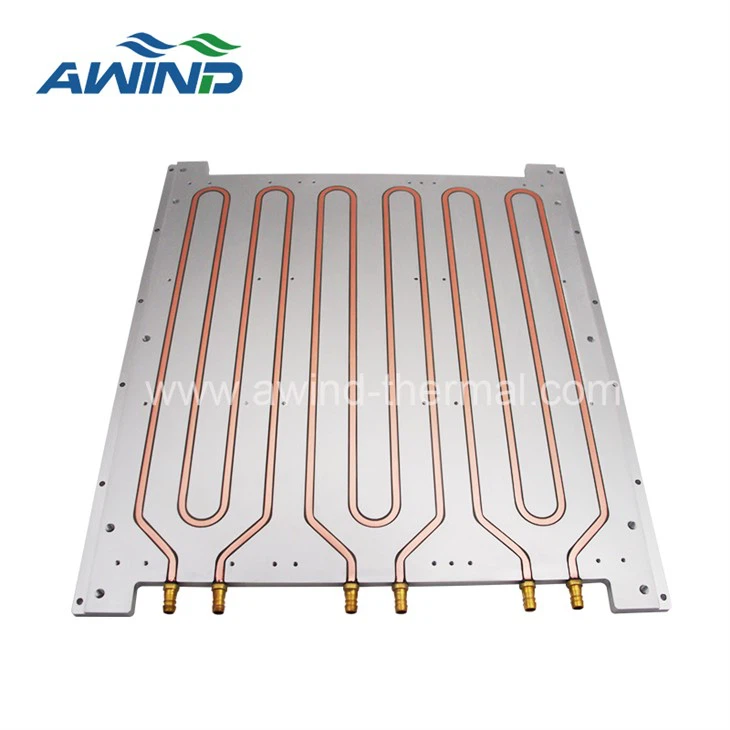
1. Buried tube water-cooled plate: This process involves embedding copper or stainless steel tubes into an aluminum alloy base plate and fixing them by pressing or brazing. Suitable for medium heat loads and specific working conditions that require corrosion resistance, with controllable costs and mature production processes.
2. Friction Stir Welding (FSW) Water Cooled Plate: A high-speed rotating stirring head is used to generate heat by friction along the edge of the cooling channel, and the substrate and cover plate materials are solid-phase welded together. Compared to traditional fusion welding, FSW has high weld strength, no porosity, excellent channel sealing, and no welding deformation.

3. Vacuum brazing water-cooled plate: The substrate, cover plate, and internal fins are brazed together in a vacuum furnace to form a whole. The internal flow channel can be made very complex, with the highest heat dissipation efficiency. Vacuum brazing can achieve extremely low thermal resistance, highest heat exchange efficiency, and ensure stable sealing in large quantities, suitable for the most demanding high-end AI processors and IGBT module heat dissipation.

Liquid cooling application: AWIND's practical experience
Although the principles of liquid cooling technology are similar, there are significant differences in the requirements for cold plates across different industries. Here are some project types that we have actually cooperated with clients to complete:
Electric vehicle battery cooling
In recent years, electric vehicles have developed rapidly, and the power density of battery packs has been increasing, resulting in an increasing amount of heat. How to timely dissipate the heat from the battery pack? The water-cooled plate is the key.
We have collaborated with multiple electric vehicle companies to design, improve, and produce customized water-cooled plates for thermal management of battery packs. From early prototype sampling to mass supply, we have helped customers solve the problems of high temperature rise and large temperature difference in battery cells under fast charging conditions.

AI server cooling
The heat load generated by AI computing is extremely high, especially in GPU servers and high-density cabinets. Traditional air cooling often fails to meet heat dissipation requirements, and excessive fan speed can cause noise and energy consumption issues.
We provide supercooled plate liquid cooling solutions for multiple AI server manufacturers, including customized cold plate design, channel optimization, and sealing verification for high-power GPUs. Some projects have entered the mass production stage.
medical equipment
Medical devices
such as CT, MRI, and high-energy laser therapy equipment require not only efficiency but also low noise and high stability in heat dissipation.
We have collaborated with medical equipment manufacturers on customized water-cooled plate projects, helping devices maintain stable temperature control during long-term operation while meeting the silent requirements of medical environments.
IGBT and Power Electronics
IGBT modules generate highly concentrated heat in devices such as photovoltaic inverters, frequency converters, and rail transit. If the heat dissipation is not timely, the increase in module junction temperature will directly affect reliability and lifespan.
We have designed various direct contact liquid cooled baseboards for IGBT modules, and by optimizing the flow channel layout to reduce thermal resistance, we have helped customers improve their power levels within the same package size.

Why choose AWIND?
1. Years of experience in thermal management design, production, and implementation
We have over 20 years of experience in thermal management, from scheme design to mass production, and have completed numerous practical projects. Our technical team will provide professional advice based on your specific project, controlling costs while ensuring performance.
2. Strict quality inspection
We have helium leak detection, ultrasonic cleaning, channel cleaning, and CMM dimensional accuracy testing for water-cooled plates to ensure no liquid leakage, no residue inside the channel, and accurate dimensions. These testing procedures are the foundation of long-term reliability.

3. Factory direct operation, controllable cost and delivery time
We are a factory with multiple production lines including vacuum brazing furnaces, reflow soldering furnaces, CNC machining centers, gear hobbing machines, stamping equipment, etc. Most of the processes can be completed in our own factory. There are no intermediate links, and the coordination efficiency between sampling and mass production is higher.

4. Served multiple well-known clients worldwide
We provide overheating management products for brands such as GE, Tesla, Cisco, V-tech, and have accumulated experience in many small and medium-sized projects. The review and long-term use of these customers are themselves a validation of the quality of our products.
Frequently Asked Questions
What is a cold plate?
A cold plate is a liquid cooled component that removes heat from electronic devices by allowing coolant to flow through internal channels.
What coolant is used in liquid cooling systems?
Common cooling fluids include water ethylene glycol mixture, dielectric coolant, and industrial coolant, depending on application requirements.
Can cold plates be customized?
Okay. Cold plates can be customized according to heat consumption requirements, size limitations, coolant types, and application environments.
Do you support making samples?
support We suggest that customers start with sampling, cooperate with high and low temperature testing and temperature rise testing, and only enter mass production after verification. This can minimize project risks to the greatest extent possible.
Conclusion
With the continuous increase in power density in the fields of AI, electric vehicles, and industrial electronics, liquid cooling technology is becoming an important solution for improving thermal performance and energy efficiency.
Compared with traditional air cooling, cold plate liquid cooling has better heat dissipation capacity, lower noise, and higher design flexibility, making it suitable for modern high-power application scenarios.
If you are looking for a customized cold plate manufacturer or OEM liquid cooling solution, AWIND can support your project from hot design to prototype validation to mass production.
Hot Tags: Custom Cold Plate Manufacturer for AI Servers, EV Batteries & Data Centers, China, suppliers, manufacturers, factory, customized, free sample, made in China, Water Cooling Plate with Copper Pipe, Water Cold Plate Heat Sink, Liquid Cold Plate with Copper Tube, Liquid Cold Plate for Power Supply, Friction Stir Welding Liquid Cold Plate, Heatsink Design


