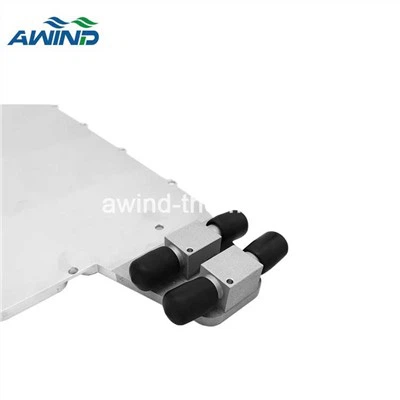
Liquid Cold Plate Cooling Heatsink For Igbt
What is IGBT?
IGBT (Insulated Gate Bipolar Transformer) is a core device for energy transformation and transmission, commonly known as the "CPU" of power electronic devices. It is widely used in fields such as rail transit, smart grid, aerospace, electric vehicles, and new energy equipment.
IGBT module is a modular semiconductor product, which is packaged by IGBT (insulated gate bipolar transistor chip) and FWD (Flyback diode chip) through specific assemble;. The IGBT module can encapsulate multiple IGBT chips internally, achieving high current processing capability to avoid the problem of increasing the active area while reducing the yield of the IGBT chip. Compared to single chip modules, packaging modules with multiple internal IGBT chips have a more responsible structure and higher requirements for thermal management. As a power device with high heat generation and greatly affected by temperature, the IGBT module must control the node temperature within a reasonable range in actual operation to ensure normal operation. Too high operating temperature will change its semiconductor Physical constant and device internal parameters, leading to the igbt module can not work properly, and even affect its working life in serious cases.

IGBT cooling technology
At present, the widely used cooling methods for IGBT in the market include air cooling technology, heat pipe cooling technology, and water cooling technology.
Air cooling technology
Air cooling technology uses the convection heat transfer zone of air to dissipate heat. It can be divided into passive Natural convection air cooling and active forced convection air cooling. The Natural convection air cooling is mainly due to the Density contrast caused by the temperature difference of the air at different positions, which generates buoyancy as the driving force to drive the surrounding air flow channel to take away the heat. The radiator of this cooling mode is simple in structure and easy to maintain, but its heat exchange capacity is poor, and can only be used during the period of low cooling power and low heat generation. With the integration of IGBT power devices and the development of high-power, the cooling demand is increasing day by day, and using only natural air cooling for cooling is far from enough.
To meet the heat dissipation needs, a fan is installed on the IGBT device to promote forced air convection. The thermal resistance of forced convection air cooling can be reduced to one-fifth to one-fifth of that of Natural convection air cooling, which greatly increases the heat dissipation capacity. However, due to the addition of fans and other devices, it is necessary to design air ducts, carry out regular maintenance, reduce the system reliability, reduce the device integration, and have a large noise when working.
In order to provide the cooling efficiency of air cooling technology, a heat sink is usually installed on the IGBT module to increase the heat exchange area, commonly known as a finned heat sink. After extensive research and optimization by AWIND, air-cooled radiators, especially parallel aluminum fin radiators, have simple design and mature manufacturing processes, making them the most commonly used heat dissipation device in current IGBT cooling. However, due to issues such as small air specific capacity and low thermal conductivity, even forced convection air cooling has limited heat dissipation capacity and cannot effectively meet the heat dissipation needs of the current high heat flux density and fast instantaneous heating of IGBT integrated modules.

Heat pipe cooling technology
The heat pipe is mainly composed of a sealed shell, a liquid suction core, and a steam channel. A certain amount of liquid is filled in the pipe. One end of the heat pipe is an evaporation section, and the other end is a condensation section. During the working process, the evaporation section absorbs the heat generated by the heat source, causing the liquid in the surrounding liquid suction core to vaporize. Then, the heat moves with the steam from the evaporation section of the heat pipe to the condensation section, and the steam condenses into a liquid in the condensation section and transfers the heat to the outside world; The condensed liquid returns to the evaporation section through the capillary action of the suction core on the pipe wall, repeating the above cycle process, continuously transferring heat from one end to the other end, thereby achieving heat dissipation.
Compared with forced convection air cooling technology, the introduction of heat pipes greatly improves the performance of heatsink. In addition, the reliability of heat pipe heatsink is high, and the risk of refrigerant leakage is low. Therefore, there is also a certain application foundation in the current igbt heat management market. But most heat pipe heatsink, like air-cooled radiators, require external fan to achieve higher heat dissipation efficiency. Therefore, the working efficiency of heat pipe heatsinks is also affected by fan form, wind speed, environmental temperature, and other factors, which require regular maintenance and may generate noise during operation. In addition, adding a heat pipe structure increases the overall size of the heat sink, which is not conducive to improving the compactness and integration of the IGBT module.

Water cooling technology
Water has good thermal conductivity, large Specific heat capacity, and almost no pollution. Compared with air cooling, water cooling has higher heat dissipation efficiency, smaller size, easier layout of the cooling system, and is more suitable for high-power igbt module cooling system. Therefore, water cooling technology has quickly been widely used, becoming the mainstream cooling mode of high-power igbt module cooling system. Combine the two independent components of the IGBT module and the water cooling plate to form a separate heat sink, which utilizes the water circulation flow inside the cold plate to remove the heat from the IGBT module.
The temperature uniformity of liquid cooling plate also needs to be taken seriously. Especially for IGBT chips, their power conversion efficiency will increase as the junction temperature of the IGBT chip decreases. Poor temperature uniformity will lead to different junction temperatures between IGBT chips at different positions, resulting in different power outputs for each IGBT chip, which is very detrimental to the operation and reliability of the module. Awind has many years of experience in designing liquid cold plate to ensure temperature balance. Ensures the normal operation of IGBT devices.

Hot Tags: liquid cold plate cooling heatsink for igbt, China, suppliers, manufacturers, factory, customized, free sample, made in China, Water Cooling Plate with Copper Pipe, Liquid Cold Plate for Power Supply, Friction Stir Welding Liquid Cold Plate, Liquid Cooling Plate, Heatsink Design, Cooling Plate Heat Sinks