Preface
The development of modern technology has put forward higher requirements for instrument accuracy, such as lasers and medical equipment, whose core components often require the use of thermoelectric coolers (TECs) to achieve precise temperature control.
However, the higher the accuracy, the more concentrated the heat generation and the higher the heat flux density. The traditional single heat dissipation method (pure air cooling or pure water cooling) is no longer able to cope with the high-intensity heat challenge generated by TECs.
Therefore, Awind innovatively proposed a composite heat dissipation solution of "water cooling+air cooling". This design not only ensures efficient and fast heat dissipation, but also effectively saves internal space of the equipment through a compact structural layout.
The working principle and heat dissipation challenges of TEC
TEC,as known as Peltier cooler, which is a solid-state energy conversion device based on the Peltier effect.
The working principle is that when a direct current passes through an electric couple composed of P-type and N-type semiconductor materials in series, heat is "pumped" from one end of the device to the other, thereby achieving the effect of cooling on one side and heating on the other. By changing the direction of the current, the cooling or heating mode can be precisely controlled.
TEC has the advantages of compact structure, no moving parts, and precise temperature control. However, it should be noted that its energy efficiency is usually lower than traditional compressor refrigeration, and a large amount of waste heat is generated on the hot surface during operation. The total heat load on its heating surface is: cooling capacity+TEC's own input electrical power. This means that if the heat cannot be dissipated in a timely manner, the TEC will experience a sharp decrease in efficiency or even permanent damage due to overheating. Therefore, an efficient heat dissipation system is the key to its stable operation.
Awind Composite Heat Dissipation Solution Detailed Explanation
Our solution utilizes a multi-layer structure to synergistically handle the high-density heat flux generated by TEC.
TEC array and interface processing
Four TECs are connected in series to form an array, in order to enhance the overall cooling power.
Using high-performance thermal conductive silicone grease to fill the micro gaps between TEC and the cold and hot end contact surfaces significantly reduces the interfacial thermal resistance.
Key details: Elastic buffer pads are installed around the TEC array, which can absorb assembly stress, prevent brittle ceramic pieces from breaking due to compression, and enhance the overall sealing and mechanical stability of the module.
Active water cooling plate (main heat dissipation channel)
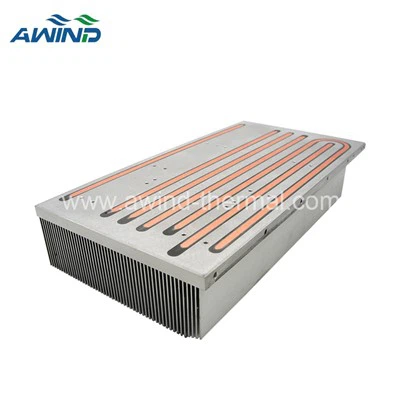
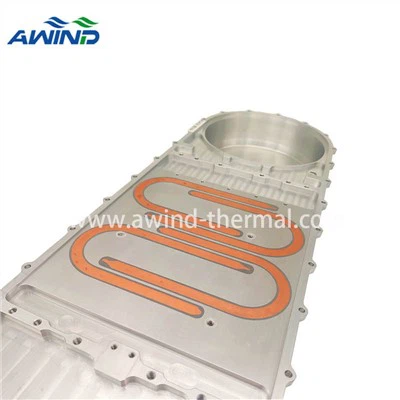
The integrated water-cooled plate made by vacuum brazing process is directly connected to the TEC hot surface.
The internal design of the water-cooled plate has optimized flow channels, fully utilizing the high specific heat capacity characteristics of water to continuously and efficiently remove the main heat from the TEC hot surface.
Auxiliary air-cooled cooling (backup and enhancement)
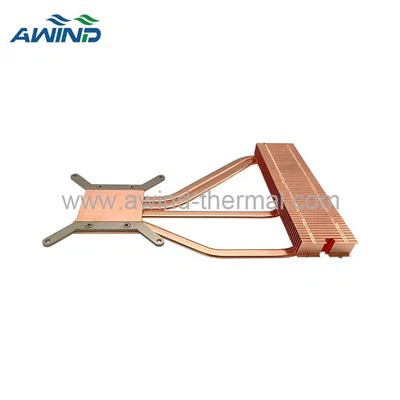
The side of the TEC module is in close contact with an aluminum substrate embedded with heat pipes.
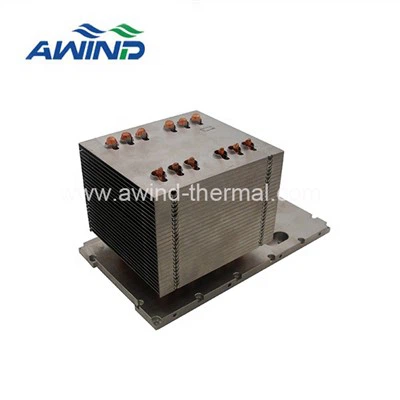
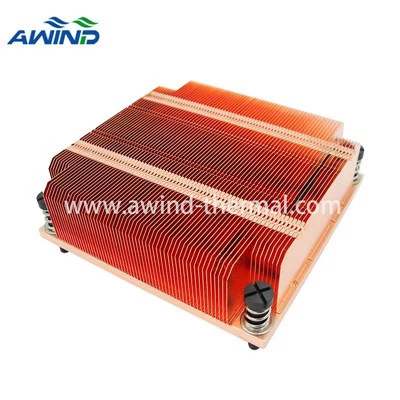
Heat is introduced into the heat pipe through the aluminum substrate and quickly directed to the high-density shovel tooth heat dissipation fins in the distance to increase the heat dissipation surface area.
Installing an axial fan above the heat dissipation fins greatly improves the air side heat dissipation efficiency through forced convection.
This air-cooled system not only serves as an auxiliary heat dissipation channel, increasing the upper limit of system heat dissipation, but also serves as a safety redundancy backup for the water cooling system, providing basic heat dissipation protection in the event of an unexpected system failure, ensuring equipment safety.


Core advantages of the plan
The coexistence of precision temperature control and high heat flux processing capability: water cooling is the main focus, and air cooling is the auxiliary, which can cope with the challenge of high heat flux density per square centimeter at the kilowatt level.
System redundancy and high reliability: Air cooling and water cooling serve as backups for each other, significantly improving the long-term operational reliability and safety of the system.
Compact structure and flexible layout: By using heat pipes to achieve "heat transfer", the heat dissipation fins and fans can be deployed in more spacious locations to meet the integration needs of various compact devices.

Typical application areas
This solution is particularly suitable for fields that have strict requirements for heat dissipation stability and accuracy:
* High power lasers: such as cavity cooling for laser diodes and fiber lasers.
* Medical and life science equipment: rapid temperature cycling of reaction modules such as PCR machines and blood analyzers.
* Military and Aerospace Electronics: Thermal Management of Airborne and Missile Electronic Equipment in Extreme Environments.
* Semiconductor Testing: Precise Temperature Control of Chip Test Stand.
* High end optoelectronic and communication equipment: Ensure stable performance of core components such as optical modules and detectors.
summary
The TEC composite heat dissipation solution launched by Awind systematically solves the overheating problem in high-power TEC applications through a triple design of "optimized thermal interface, active water cooling dominance, and redundant air cooling enhancement". This solution not only achieves the ultimate performance beyond traditional single heat dissipation methods, but also provides stable and durable temperature control guarantees for various precision instruments and equipment with modular and highly reliable design concepts. It is an ideal heat dissipation choice to promote high-precision technology equipment to move towards higher performance levels.
Hot Tags: tec thermal management: advanced hybrid cooling design, China, suppliers, manufacturers, factory, customized, free sample, made in China, Vapor Chamber, OEM Heat Sink, High Quality Heat Sink, Zipper Fin Heat Sink, High Quality Cooling Heat Sink, CPU Heat Sink Design