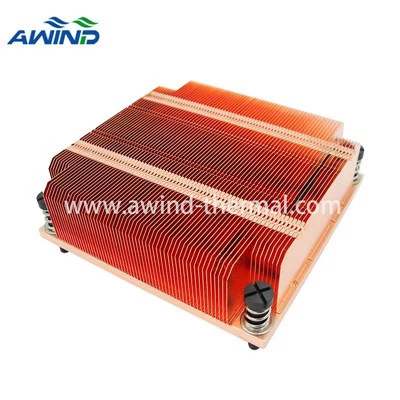
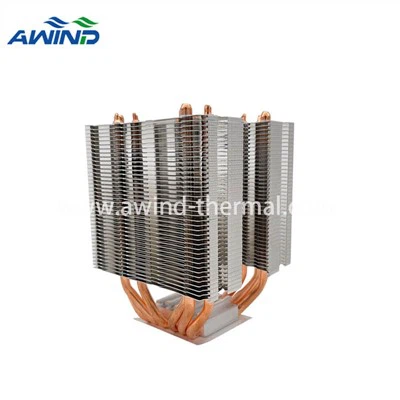
Heatsinks With Heatpipes / Vapor Chamber
In different applications, engineering decisions regarding the optimal solution for heat sinks may depend on cost and performance. In theory, obtaining the lowest cost product to meet performance requirements seems easy. In fact, customers often choose to change performance specifications (using different chips) or sacrifice some performance (such as degrading chips based on conditions) when facing high prices.
This article compares several heat sinks based on heat pipes/vapor chamber for performance and cost indicators:
Performance: Use FloTHERM CFD software package to calculate the overall heat sink performance Δ T.
Cost: Assuming the batch size is large enough, the investment cost of the hard mold will not be reflected in the unit price. In addition, the unit price is relative to the lowest cost solution (1 times, 1.1 times, etc.), as increasing the batch size will lower the unit cost.
Heatsink design parameters
Heat source power: 250 watts
Heat source size: 30 x 30 mm
Maximum ambient temperature: 25 ℃
Air flow rate: 40 cubic feet per minute (CFM)
Condenser: snap on fin size 115 * 85 * 65 mm
Let's start with the most basic design and gradually delve into complex processes to see how performance and cost are affected by design.
1. Aluminum or copper based heat pipe heatsink
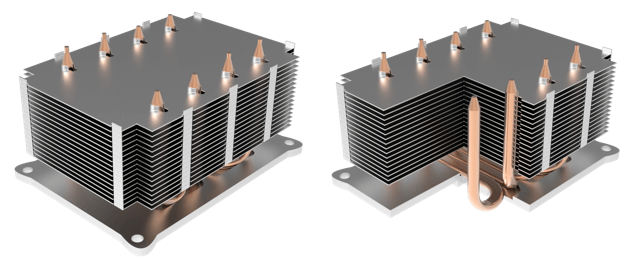
U-shaped aluminum base heat pipe heatsink
This is the most traditional design of a heat pipe radiator. Four U-shaped heat pipes are welded to an aluminum or copper base and then in contact with a heat source. Heat must first pass through the base then they can reach the heat pipe.
Apart from bending, no other secondary operations were performed on the four 6mm heat pipes, although the contact area between the heat pipes and the base in this example is slightly flat.
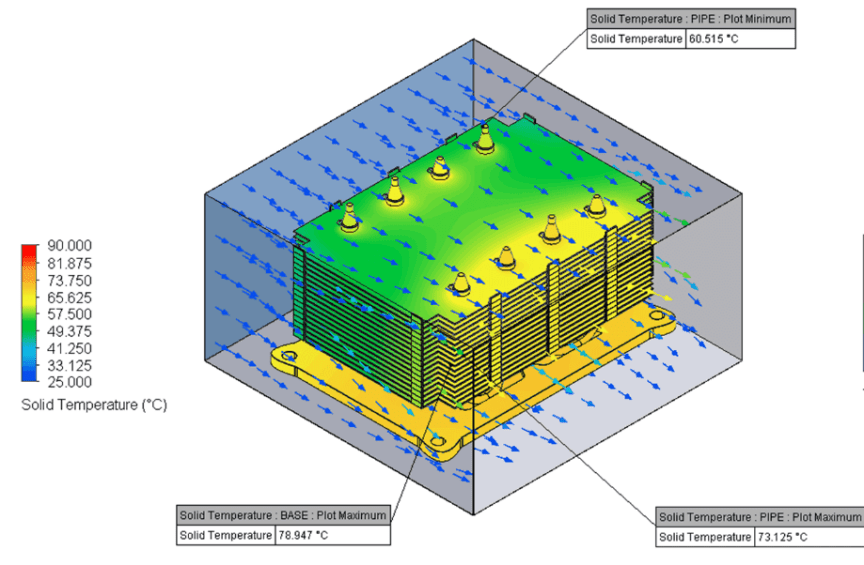
CFD of Aluminum Base Heat Pipe Radiator
The FloThermal model shows that the heat sink temperature is 53.9 ℃ higher than the ambient temperature (78.9 ℃ -25 ℃=reference maximum temperature - ambient temperature), and we use this temperature as the performance benchmark, with a cost benchmark defined as 1 time.
If higher performance is required, a copper base can be used instead of an aluminum base. The thermal conductivity of copper base is twice that of aluminum base, so the performance of copper base is improved by 2.3 ℃. The copper base design increases the cost by 5% compared to the aluminum base, and there is also a slight increase in weight.
2. Direct contact heat pipe heatsink radiator
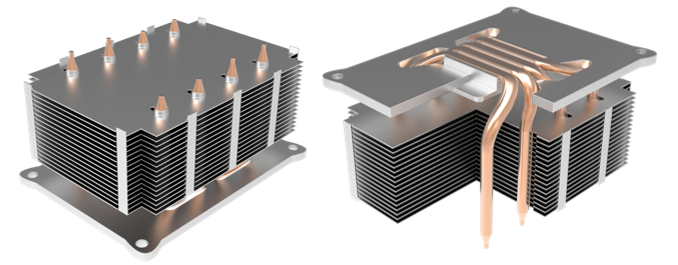
Direct contact heat pipe radiator
This design allows for direct contact between the heat source and the heat pipe, thereby eliminating the heat absorbing base and interface materials (solder used to secure the heat pipe to the base). However, in order to obtain the necessary surface smoothness, the heat pipe must be machined (secondary operation).
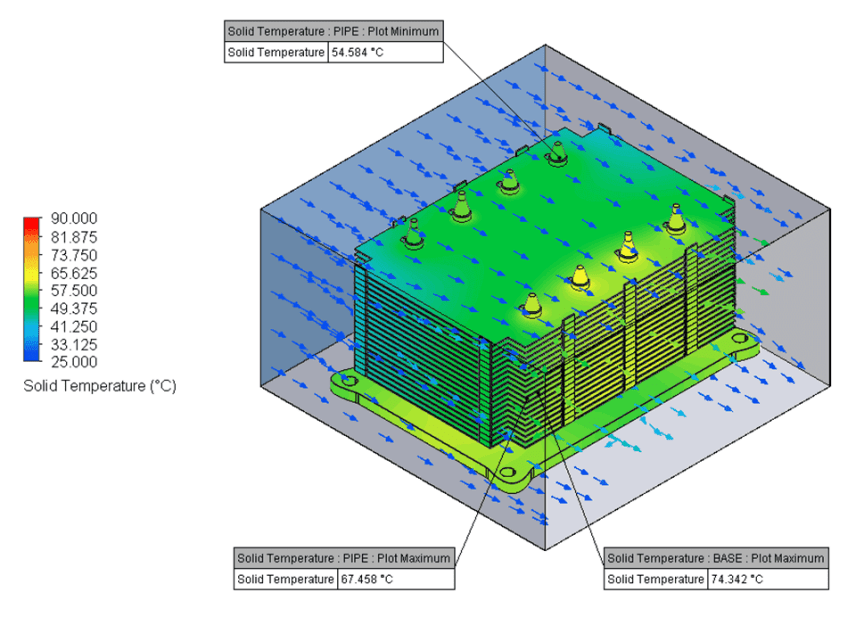
CFD of Direct Contact Heat Pipe Radiator
Due to direct contact between the heat pipe and the heat source, the performance of this design of heat sink has been improved to 49.3 ℃, which is 4.6 ℃ higher than the benchmark and 2.3 ℃ higher than the design using a copper base. However, it requires additional processing of the base (embedding grooves of the heat pipe) and processing of the heat pipe, which is 1.1 times the cost of the benchmark design (10% more expensive).
3. U-shaped uniform temperature plate heat sink
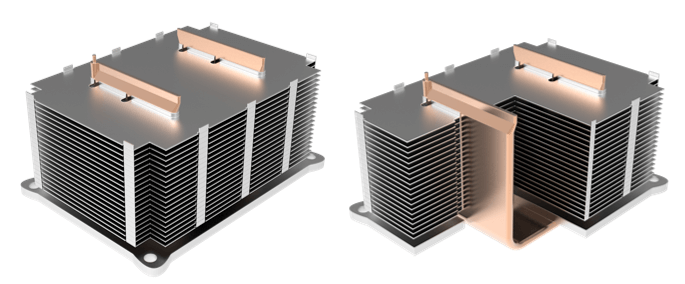
U-shaped uniform temperature plate heat sink
This solution replaces four 6mm heat pipes with a single U-shaped vapor chamber. In terms of design, it is most similar to a direct contact heat pipe heat sink, both of which allow the heat source CPU to come into direct contact with the two-phase components. The important consideration for choosing this design is whether the heat sink supplier can manufacture an integrated vapor chamber, as traditional two-piece designs cannot be bent into a U-shape.
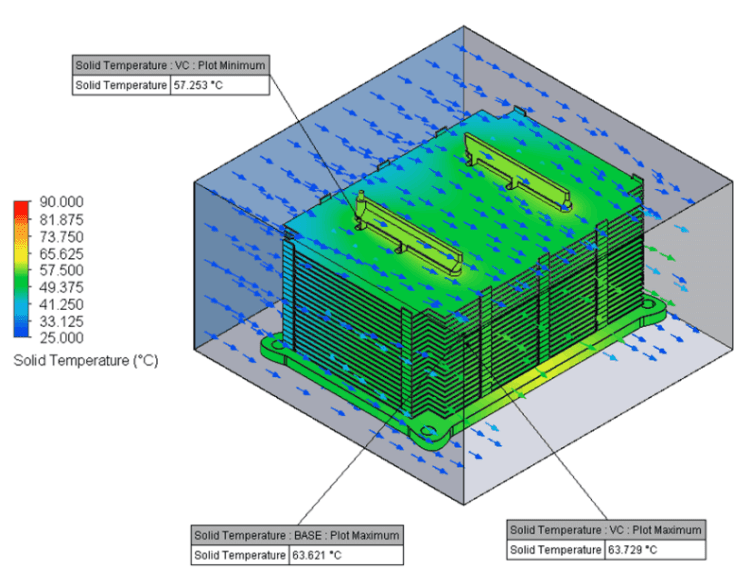
CFD of U-shaped uniform temperature plate heat sink
Compared to the direct contact heat pipe design, the performance of the vc heatsink solution has improved by 21.5% (11.6 ℃), while the cost has only increased by 4.55%. However, the increase in wall thickness of vc heatsink resulted in an increase of approximately 75g in the weight of the heatsink radiator.
4. 3D uniform temperature plate heat sink
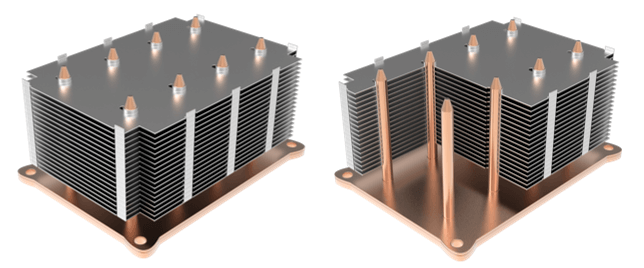
3D uniform temperature plate heat sink
In this design, the heat absorbing bottom plate is a vapor chamber that shares a steam passage with the vertical condenser heat pipe. During the manufacturing phase, 8 open type heat pipes are brazed into a vapor chamber plate with openings; The vapor chamber is in direct contact with the heat source, evenly distributing heat along the XY plane, and dispersing heat to the fins through vertical heat pipes.
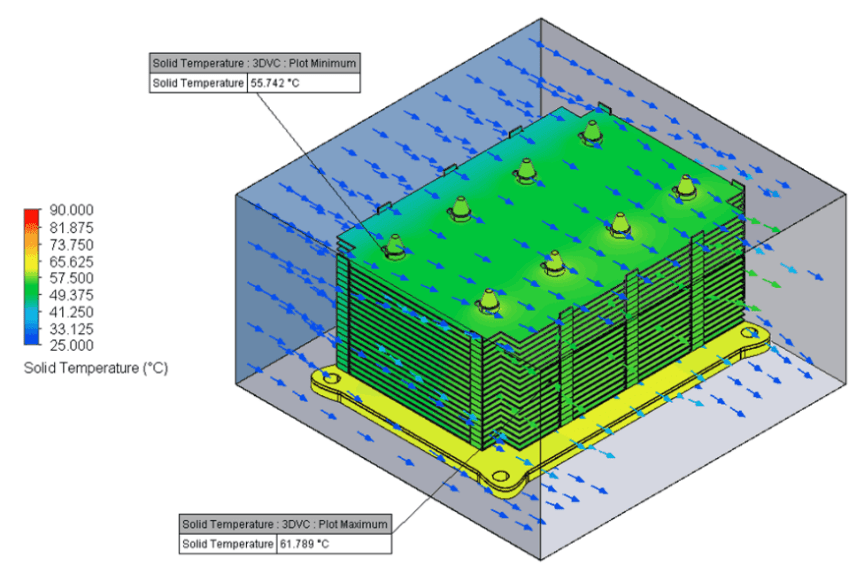
CFD of 3D heat sink with vapour chamber
This design has the best performance, but the cost is high. Compared to its closest competitor, the U-shaped vc heatsink plate design, its temperature has decreased by nearly 2 degrees (performance has increased by 4.9%), but its price has doubled (increased by 117%).
However, it should be noted that this case did not fully highlight the potential advantages of 3D vapor chamber design. As the required bottom plate size increases, the performance difference between this solution and the U-shaped vapor chamber plate design also increases.
summary
The table below shows that changing the material or two-phase components of the heat sink can achieve a considerable performance improvement. From the benchmark aluminum based heat sink to the 3D vc heatsink plate solution, the performance has been improved by 17 ℃, but the cost has increased by 150%.
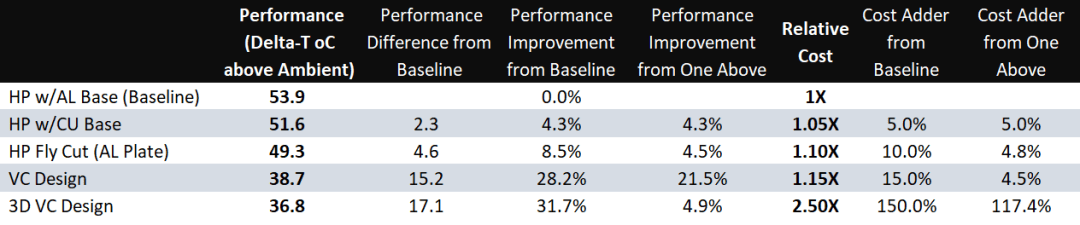
Comparison of radiator performance and cost
By replacing the base with copper material with stronger thermal conductivity or making the heat pipe in direct contact with the heat source, a moderate performance improvement of about 7% -15% and cost increase (relative to the benchmark) can be achieved.
The design with the best overall value given the application parameters may be a vapour chambers heat sink. Although it is 15% more expensive than the benchmark price, its performance has improved by 28% (by 15.2 ℃).
Hot Tags: 250w heatsinks with heatpipes / vapor chamber, China, suppliers, manufacturers, factory, customized, free sample, made in China, OEM Heat Sink, Heat Sink with Copper Heat Pipe, CPU Heat Sink Design, Vapor Chamber, High Quality Heat Sink, Zipper Fin Heat Sink