Liquid Cooling Plate Technology: The Core Driver Powering the Industrial Upgrade of Supercharging Piles
Amid the rapid growth of the new energy vehicle (NEV) industry, technological innovation in charging infrastructure has become pivotal for breakthroughs. As a core component enabling high-power charging, liquid cooling plate technology is reshaping the technical architecture of supercharging piles with its efficient thermal dissipation and stable temperature control capabilities, laying the foundation for the intelligent and scalable development of future charging networks.

1.Thermal Challenges in High-Power Charging and Technological Innovation
As EV driving ranges expand and user demand for faster charging intensifies, supercharging pile power has surged from early 60kW levels to 480kW and beyond. This exponential increase in power density poses significant thermal management challenges: critical components such as power electronics and cable connectors generate substantial heat during charging. Inadequate heat dissipation not only reduces efficiency and shortens equipment lifespan but also raises safety risks. Traditional air cooling, limited by low specific heat capacity and insufficient thermal efficiency, struggles to meet high-power temperature control demands. Liquid cooling plate technology, leveraging circulating liquid media, has emerged as the solution.
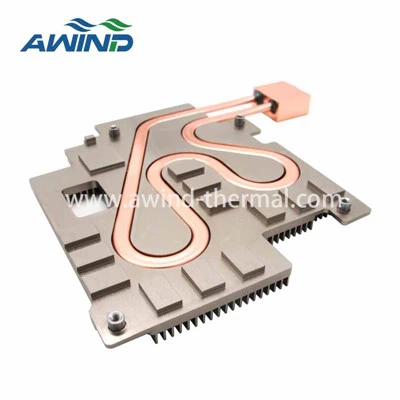
Liquid cooling plates utilize intricately designed internal flow channels and the high heat capacity of coolants to rapidly absorb and transfer heat. The process involves coolant circulating through contact surfaces of heat-generating components via pumps, absorbing heat before exchanging it in external radiators, forming a closed-loop system. Compared to air cooling, liquid cooling plates improve thermal conductivity by 3-5 times while offering compact size, low noise, and robust environmental adaptability. These traits enable effective mitigation of thermal accumulation in supercharging piles under sustained high loads.
2.Systemic Breakthroughs in Liquid Cooling Plate Technology
Current R&D focuses on three dimensions: material science, structural design, and intelligent control.
Materials: High-thermal-conductivity aluminum/copper alloys and composite materials enhance heat exchange efficiency. Experimental use of graphene coatings and nanofluids pushes performance toward theoretical limits.
Flow Channel Design: Integrating biomimetic principles with computational fluid dynamics (CFD) simulations has evolved traditional parallel channels into fractal tree-like and spiral vortex topologies, optimizing heat distribution while reducing pressure loss.
Smart Control: Embedded temperature sensors and AI algorithms enable real-time monitoring and dynamic adjustment of coolant flow rates. This predictive thermal control stabilizes temperatures within ±2°C while optimizing energy consumption based on ambient conditions and charging power, boosting overall efficiency by 15-20%.
3.Industry Chain Collaboration and Scalable Application Prospects
The adoption of liquid cooling plate technology is reshaping the charging equipment supply chain:
Upstream: Material suppliers prioritize specialized metal processing and sealing material R&D.
Midstream: Manufacturers integrate liquid cooling plates with IGBT modules and charging cables into modular thermal management units.
Downstream: Operators leverage the technology to overcome power density bottlenecks, enabling compact designs and higher site utilization.
This vertical integration reduces supercharging pile construction costs by 30% per watt, making dense urban deployment economically viable. As global EV penetration accelerates, liquid cooling plate technology will remain central to advancing ultra-fast charging infrastructure, driving the transition to sustainable mobility.
Hot Tags: liquid cooling plate technology: the core driver powering the industrial upgrade of supercharging piles, China, suppliers, manufacturers, factory, customized, free sample, made in China