
What is the R-angle of a Water Cooling plate?
Bending radius refers to the inner corner radius of the bent part during the bending process of water cooling plate.
For example, if an aluminum plate with a thickness of 3mm is bent at a 90 ° angle, the radius of the inner curved area is what we call the R angle.

The red arrow is the R angle
The role and importance of R angle
Reasonable design of R angle is of great significance for improving the reliability and heat dissipation performance of liquid cold plates, which is reflected in the following aspects:
1. Prevent material cracking
If the R angle is too small during bending, the material is prone to fracture due to local stress concentration, especially for metals with poor ductility such as aluminum alloys.
2. Improve assembly accuracy and consistency
A suitable R-angle design helps achieve high-precision docking of water-cooled plates in the entire system, improving assembly efficiency and overall heat dissipation consistency.
3. Ensure the integrity of the cooling channel
A too small R angle may compress or damage internal cooling structures (such as laser welding channels, microchannels, etc.), affecting fluid flow and thereby reducing cooling efficiency.
4. Optimize welding structure design
Water cooled plates are often connected to cover plates through friction welding, laser welding, and other welding processes. A reasonable R-angle can improve welding quality and sealing reliability.

The direct impact of R-angle bending on the performance of water-cooled plates
The design of R-angle not only relates to the feasibility of structural forming, but also directly affects the performance of water cool plates, including:
1. Is there any cracking or flattening of copper or stainless steel pipes;
2. Whether the internal flow channel remains unobstructed;
3. Whether the overall structure has undergone deformation;
4. Has the heat dissipation efficiency decreased due to local backflow, dead corners, and other issues.
Comparison of R-angle design between copper and stainless steel pipes in liquid cold plates
In buried tube water cooling plates, copper pipes and stainless steel pipes are commonly used due to their excellent thermal conductivity and mature processing technology. However, due to material differences, they have both similarities and significant differences in R-angle design.
common ground:
1. The principle of minimum bending radius must be followed
Both types of pipes must ensure that the bending radius is not less than the minimum allowable value to prevent cracking, flattening, or wrinkling of the inner wall.
2. R angle is closely related to pipe diameter
The R angle is usually estimated using the method of "pipe outer diameter x coefficient", such as R ≥ 5~8 x pipe outer diameter.
3. Affects the smoothness of flow channels and heat dissipation performance
A too small bending radius can cause an increase in flow resistance, a decrease in flow velocity, and even create local heat dissipation blind spots.
4. The R angle must be clearly marked in the drawing
Cannot default to processing, otherwise the actual finished product may deviate significantly from the design.
Differential comparison:
| Comparison item | Copper tube (annealed hose) | stainless steel tube (such as 304/316) |
| Minimum bending radius | R ≥ 5 x outer diameter (smaller) | R ≥ 6-8 x outer diameter (larger) |
| Processing difficulty | Easy to bend, suitable for mold/manual bending | Difficult to bend, usually requiring CNC equipment or heat treatment support |
| Springback | Small, stable after molding | Large, compensation angle needs to be reserved |
| Limitations on structural design | Strong adaptability, suitable for compact structural design | There are many restrictions, and more bending space needs to be reserved |
| Reliability after molding | Less stress concentration and high lifespan | If the R angle is insufficient, it may crack during thermal expansion and contraction |

Why is stainless steel tube still frequently used on Liquid cooling plates despite its lower processing difficulty, bending angle, and thermal conductivity compared to copper tube?
1. Strong corrosion resistance. Stainless steel exhibits strong corrosion resistance to water, ethylene glycol, fluorine coolant, oil, etc., making it suitable for harsh environments such as seaside, chemical plants, and outdoor exposure
2. High compressive strength. Stainless steel pipes have thin walls but high strength, and can withstand higher working pressures (such as greater than 1MPa) without deformation or bursting
3. Resistant to high temperature oxidation. Not easily oxidized at high temperatures, suitable for use in equipment with high hot end temperatures (such as lasers, power electronics)
4. Good compatibility. Stainless steel material has good chemical stability and is suitable for applications with diverse fluid types or high cleanliness requirements, such as medical equipment and experimental equipment
5. Good mechanical stability. Stainless steel has high hardness and elastic modulus, making it difficult for the structure to deform or fatigue crack after long-term use
If pursuing long-term reliability, chemical stability, or environmental adaptability, stainless steel pipes must be considered.
Although stainless steel pipes are difficult to bend and have poor thermal conductivity, their corrosion resistance, high pressure, and high temperature performance under harsh working conditions cannot be replaced by copper pipes. Its' disadvantage 'is actually an' advantage 'in some situations - it is precisely because it is' hard enough and stable enough' that it is suitable for high-end cooling scenarios.
Some water cooling plate heat sink applications that commonly use stainless steel pipes as flow channels. For example: medical equipment (such as MRI), lasers/industrial cutting, energy storage/communication equipment, chemical/semiconductor equipment, high-pressure cooling systems.

Awind's leading R angle bending technology for stainless steel tube water-cooled plates
In the R angle bending process of high difficulty stainless steel tube liquid cooling plates heatsink, Awind is at the forefront of the industry with excellent design capabilities and manufacturing processes.
As is well known, stainless steel is harder and more elastic than copper, and is more prone to problems such as rebound and pipe cracking during bending. Especially when pursuing small R angles, its processing difficulty increases geometrically. Therefore, achieving small R-angle bending while ensuring the integrity of the cooling channel and thermal conductivity efficiency is a huge challenge for the technical process.
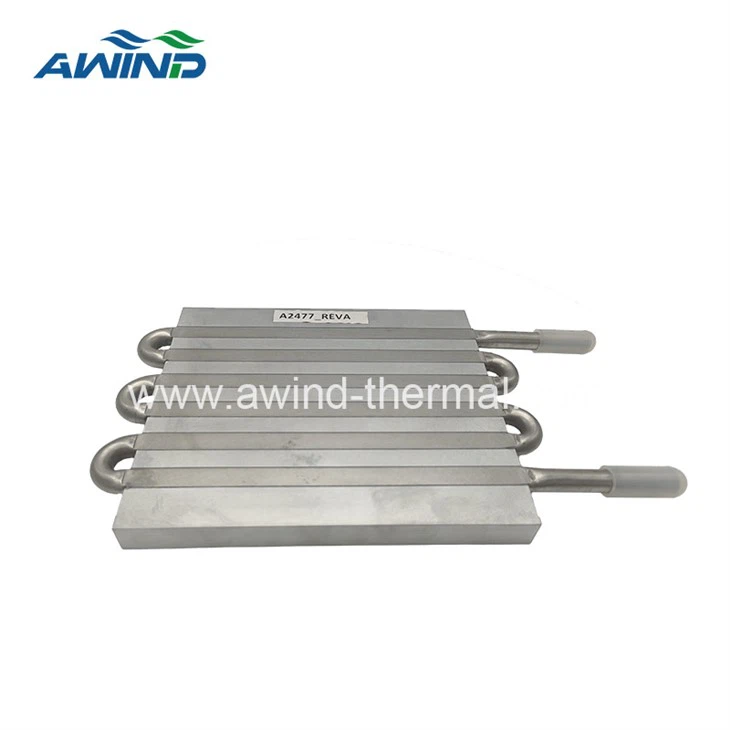
Awind has been focusing on the research and manufacturing of water cooling plate products for many years, constantly overcoming technical difficulties such as bending, assembly, and welding, and ultimately creating a water cooling plate with stainless steel tube that represents the industry's technological height. It performs excellently in small R-angle control, channel maintenance, thermal resistance optimization, and other aspects.
The product highlights the following parameters:
Size specifications: 152.4mm × 133.35mm × 13.97mm (L × W × H)
Substrate material: AL6063 aluminum alloy
Buried pipe material: SUS stainless steel pipe, diameter D9.53mm, wall thickness T0.89mm
Minimum R-angle achieved: 9.02 mm (recommended to fill in actual value)
In the design of water-cooled plates, the recommended value for R-angle (bending radius) is usually 3-5 times the outer diameter of the pipe to ensure the forming quality and fluid smoothness of the pipe during the bending process. The commonly used calculation formula is:
R=k×D
Among them:
R represents the bending radius (unit: mm)
D is the outer diameter of the pipeline (unit: mm)
K is the material coefficient, with a general range of values as follows:
Copper tube: 3-4
Stainless steel pipe: 4-5
Taking the stainless steel cooling pipe in this example as an example, with an outer diameter of 9.53 mm (i.e. 3/8 inch), the recommended minimum bending radius is:
𝑅=(9.53/2)×4=19.06mm
But in fact, we can achieve the R=9.02mm
This extremely small bending radius design is extremely challenging even for copper pipes, but Awind has implemented this process on stainless steel pipes, ensuring stable and reliable overall board performance, and continuously leading heat dissipation efficiency. This product fully demonstrates Awind's profound expertise in precision bending, complex channel control, and heat dissipation system optimization.
conclusion
The R angle of the water cooling plate, although a small detail, is related to structural safety, heat dissipation performance, and manufacturing cost. Awind's leading performance in stainless steel tube bending technology not only solves multiple technical problems in high-density and compact structures, but also provides strong support for high-end equipment thermal management.
If you need more technical information or sample support, please feel free to contact Awind's professional team. We will provide you with customized and highly reliable thermal solutions.
Hot Tags: awind's leading r angle bending technology for stainless steel tube wate cooling plates, China, suppliers, manufacturers, factory, customized, free sample, made in China, Heatsink Design, Liquid Cooling Plate, Liquid Cold Plate for Power Supply, Cooling Plate Heat Sinks, Vacuum Brazing Liquid Cold Plate, Water Cold Plate Heat Sink