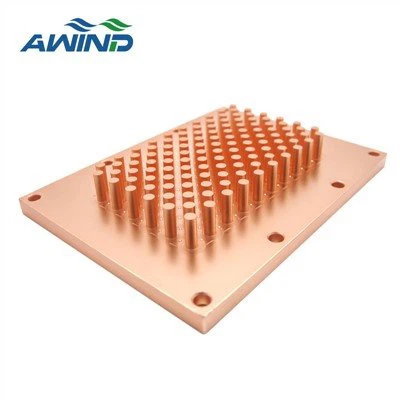
Water Cooling Plate For Energy Storage
The cooling method of the energy storage system is related to the safety, cost and efficiency of energy storage system. At present, the main cooling methods are natural cooling, forced air cooling and liquid cooling, which are applied in different occasions respectively. In the large-scale application of large container energy storage, the liquid cooling energy storage system receives more attention. Then, how to select various cooling methods requires comprehensive consideration of safety, efficiency, economy and other aspects of the system.
(1) Natural cooling. Natural cooling is a cooling method that uses the high thermal conductivity of metal materials to take away heat and dissipate it into the air. It refers to natural convection without specific wind speed requirements. The heat sink used is copper, aluminum.
(2) Forced air cooling. Forced convection is used for heat dissipation. When there are special wind speed, the wind speed can realize convection through the fans. The configuration of fan radiator, high-density heat sink plate and heat exchanger can create an opposed or cross airflow environment to accelerate heat removal and improve heat dissipation efficiency.
(3) Liquid cooling technology. Liquid cooling application refers to the use of liquid cooling plates (also known as water-cooled cooling plates) installed at the heat source to cooperate with the heat sink unit to dissipate heat in a fluid circulation manner. In general, liquid cooling technology is mostly used in forced convection phase change systems or in environments where heat energy density is extremely high and heat dissipation effect cannot be achieved.

In the energy storage system, the current low-power systems, such as power packs, mobile phones, laptops, etc., generally use natural heat dissipation. Medium power systems, such as portable power supply, household energy storage system, UPS, small and medium-sized industrial container energy storage, generally adopt forced air cooling. Electric vehicle energy storage system generally adopts water cooling technology. At present, medium and large energy storage systems also begin to use water cooling technology.
The energy storage system mainly refers to the battery energy storage system, which is generally composed of battery system, PCS system, BMS system, monitoring system, etc. The battery system is composed of single batteries in series and parallel. According to the current common 40 foot 2.5MWh air-cooled energy storage container, about 6510 120Ah cells, 2790 280Ah cells and thousands of cells are stacked together. The charging and discharging efficiency of the energy storage system is about 90%, which will generate a lot of heat during operation, and these heat needs to be distributed in time, Otherwise, the battery life will be affected and even the thermal runaway will occur, which will bring fire risk.
The air cooling heat dissipation brings the heat generated by the electric core to the outside through the fan, and the liquid cooling heat dissipation conducts heat convection through the coolant. Air cooling technology was first widely used in the energy storage system because of its simple structure, mature technology and low cost, which can realize rapid delivery and deployment. However, the air cooling system has a large volume and is greatly affected by the external environment. There are many problems in system safety, efficiency and economy. The emergence of liquid cooling energy storage just solves the above problems.

Energy storage liquid cooling system
1. Principle of energy storage water cooling system
Liquid cooling system is a hot research direction of thermal management of power battery at present. The best working temperature condition of battery pack can be achieved by utilizing the performance of large thermal capacity of coolant and the ability to take away excess heat of battery system through circulation. The basic components of the liquid cooling system include: liquid cooling plate, liquid cooling unit, liquid cooling pipeline, high and low pressure wire harness; Coolant, etc.
2. Main advantages of energy storage liquid cooling system
(1) More secure. With the continuous increase of the construction scale of energy storage projects, the capacity of single battery and the energy density of the system will increase accordingly. Even if large capacity cells are used, hundreds of thousands or even hundreds of thousands of cells will still be required to build a 100 MW energy storage project, which will generate more heat and put forward higher requirements for the temperature control management of the energy storage system. The liquid cooling energy storage technology has a high content. It can directly dissipate heat from the electric core through the convection of the coolant. The method is controllable and is not affected by external conditions. Moreover, the heat dissipation efficiency is high and the temperature control is more accurate. Due to the small air specific heat capacity, convection heat transfer coefficient and other factors, the battery air cooling technology has low heat transfer efficiency, and the battery heat generation increases, which will lead to high battery temperature and risk of thermal runaway; The liquid cooling scheme can force the battery pack to dissipate heat and realize the heat redistribution between battery modules by relying on large flow of cooling medium, which can quickly inhibit the continuous deterioration of thermal runaway and reduce the risk of runaway.
(2) More economical. In addition to safety, the integrated design of the energy storage system should also take into account the operation and maintenance of the whole life cycle. The liquid cooled energy storage system is more economical. The operation of the energy storage system generates large heat and uneven heat dissipation, which not only endangers the safety of the battery energy storage system, but also affects the battery life. Through the cluster level controller and intelligent temperature control equalization control technology, the energy storage liquid cooling system can make the temperature of the electric core more uniform through the setting of pipes and liquid flow. In order to achieve the same average battery temperature, air cooling requires 2-3 times more energy consumption than liquid cooling. Under the same power consumption, the maximum temperature of the battery pack is 3-5 ℃ higher for air cooling than for liquid cooling, and the power consumption of liquid cooling is lower.
(3) More suitable for long-term energy storage. If the 4h battery energy storage system continues to use the air cooling heat dissipation technology, although its structure is simple and its cost is low, and the heat generated by the battery cell is directly brought to the outside through the fan, it has the disadvantages of low heat transfer coefficient, slow cooling speed, and the need for a large area of heat dissipation channel, and its area will be very large. The liquid cooling technology has the advantages of high thermal conductivity, more uniform heat dissipation, lower energy consumption, and less floor space. The container solution of the liquid cooling energy storage system has high heat dissipation efficiency. Compared with the traditional air-cooled container, the power density is increased by 100%, and the floor space is saved by more than 40%. It is more suitable for large-scale and long-term energy storage scenarios.
Hot Tags: water cooling plate for energy storage, China, suppliers, manufacturers, factory, customized, free sample, made in China, Heatsink Design, Liquid Cold Plate for Power Supply, Liquid Cooling Plate, Water Cooling Plate with Copper Pipe, Cooling Plate Heat Sinks, Liquid Cold Plate with Copper Tube