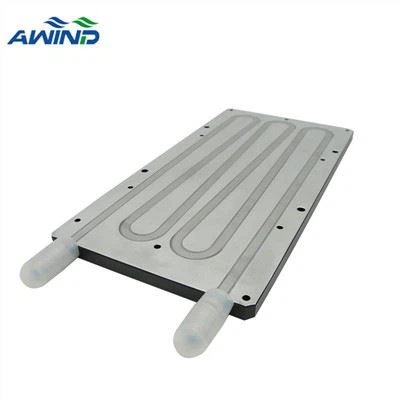
Large-Format, 40 mm-Thick Aluminum Liquid Cold Plate with Laser Welding
Not every liquid cold plate is a thin, standard-size component. For projects requiring larger dimensions and thicker structures, both the internal flow channel design and the joining process need careful consideration.
AWIND recently developed a custom aluminum liquid cold plate measuring 730 × 558 × 40 mm (L × W × H). Manufactured from AL6061-T5 aluminum alloy, this large-format cold plate features a customized M-shaped flow channel and a laser-welded structure.
The internal channel measures 20 mm in depth and 10 mm in width, with one inlet and one outlet positioned on the same side of the plate.
One of the main considerations during manufacturing was the limited space around the welding area. Since the flow channel runs close to the machined edge, AWIND evaluated both Friction Stir Welding (FSW) and laser welding before selecting the more suitable process for this design.
In this case study, we will look at the cold plate structure, flow channel design and the reasons behind the welding process selection.

1. Product Overview: Large-Format AL6061-T5 Aluminum Cold Plate
With an overall length of 730 mm, a width of 558 mm and a thickness of 40 mm, this is a relatively large and thick aluminum liquid cold plate.
The product is made from AL6061-T5 aluminum alloy and features a customized internal channel rather than a standard cooling passage layout.
Key specifications include:
| Item | Specification |
|---|---|
| Product Type | Large-Format Aluminum Liquid Cold Plate |
| Material | AL6061-T5 |
| Overall Dimensions | 730 × 558 × 40 mm (L × W × H) |
| Flow Channel | Custom M-Shaped Design |
| Channel Depth | 20 mm |
| Channel Width | 10 mm |
| Inlet / Outlet | 1 Inlet + 1 Outlet |
| Port Position | Both on the Same Side |
| Joining Process | Laser Welding |
| Surface Roughness | Ra < 3.2 μm |


2. Custom M-Shaped Flow Channel Design
The flow channel is one of the key design features of this cold plate.
For this project, AWIND developed an M-shaped channel measuring 20 mm deep and 10 mm wide. The layout guides coolant across a larger portion of the plate instead of following a short, direct path.
The purpose of this design is to extend the coolant flow path and provide a larger internal heat exchange area, helping the cooling system transfer heat through the cold plate.
The plate has one inlet and one outlet, both located on the same side to meet the product's structural requirements.
Flow channel layouts are not limited to this M-shaped configuration. AWIND can customize channel paths, dimensions and port arrangements according to customer drawings and cooling requirements.

3. FSW vs. Laser Welding: Which Process Fits This Design?
Once the product structure was determined, another important question was how to join the aluminum components.
AWIND considered two processes: Friction Stir Welding (FSW) and laser welding. Both can be used for aluminum components, but they work differently and have different requirements for the welding area.
Friction Stir Welding (FSW)
FSW uses a rotating tool to generate frictional heat and stir the softened aluminum material along the joint. The material is joined in a solid state without conventional melting.
⑴. Some of its characteristics include:
⑵. Solid-state joining without forming a conventional molten weld pool.
⑶. Good joint integrity when the tooling and process parameters are properly controlled.
⑷. Suitable for many aluminum plate structures.
⑸. Requires sufficient clearance for the rotating tool and shoulder to travel along the welding path.
For structures with narrow working areas or flow channels positioned close to the joint, tool access needs to be considered carefully.

Laser Welding
Laser welding uses a concentrated laser beam to locally melt and join the aluminum components.
Its main characteristics include:
⑴ Focused heat input around the welding position.
⑵ No rotating stirring tool in contact with the workpiece.
⑶ More flexible positioning of the welding path where suitable beam access is available.
⑷ Potential for precise welding in relatively compact structural areas.
However, proper control of surface cleanliness, joint gaps and welding parameters is still important for consistent weld quality.
For a closer look at this process, see our article on Laser Welding in Heat Sink Manufacturing.

4. Why Laser Welding Was Selected for This Aluminum Cold Plate
For this particular cold plate, the welding decision came down to the actual space available around the joint.
The M-shaped flow channel is positioned relatively close to the machined edge of the plate. This leaves limited working clearance around certain welding areas.
With FSW, the rotating tool and shoulder need enough physical space to follow the joint. In this design, accommodating the tool along the intended welding path would make the process more challenging.
Laser welding offered a more suitable approach. Without a rotating tool pressing against and moving along the workpiece, the laser beam can be directed toward the intended joint with greater flexibility.
After comparing the two processes, AWIND selected laser welding for this cold plate. The decision was based on the available working space, the position of the internal flow channel and the sealing requirements of the product.
This project also shows why welding process selection should be based on the actual product structure rather than applying the same method to every aluminum cold plate.

5. AL6061-T5 Material and Precision Machining
This large aluminum cold plate is manufactured from AL6061-T5 alloy.
In addition to the material and structural requirements, the machined surfaces also need to meet the specified finish requirements. For this project, the required surface roughness is Ra below 3.2 μm.
The machining process is controlled to achieve the required surface condition on the designated areas of the cold plate.
For more information about aluminum alloy temper conditions, you can also read our guide on T4, T5 and T6 Aluminum Temper Conditions.
6. Pneumatic Pressure-Hold and Immersion Leak Test
A welded liquid cold plate needs to be checked for leakage before it is accepted.
For this 730 × 558 × 40 mm aluminum cold plate, AWIND performed a pneumatic pressure-hold and immersion leak test at 1 MPa for 10 minutes.
The test involved several steps:
The outlet was plugged to close the internal flow channel.
Compressed air was introduced through the inlet until the pressure reached 1 MPa.
The inlet was sealed to maintain the internal pressure.
The cold plate was immersed in water for a 10-minute inspection.
During the test, two things were checked:
Bubble inspection: The submerged cold plate was observed for air bubbles. No bubbles were detected during the test.
Pressure inspection: The pressure reading was monitored during the holding period and checked against the specified allowable pressure range to determine whether any pressure drop exceeded the acceptance limit.
The tested unit met the specified leak-tightness requirements, with no visible air bubbles and an acceptable pressure reading after the 10-minute holding period.
This combined inspection helps verify the sealing performance of the welded structure under the specified test conditions.
For more information about liquid cold plate inspection, see our article on Quality Inspection Methods for Liquid Cold Plates.
7. AWIND: Custom Large-Format and Thick Aluminum Liquid Cold Plates
This project is an example of AWIND's experience in manufacturing large-format and thick aluminum liquid cold plates.
From this 730 × 558 × 40 mm AL6061-T5 plate to customized internal flow channel layouts, different product structures can require different machining and joining solutions.
AWIND supports custom liquid cold plate projects with a focus on:
Large-format and thick aluminum structures: Custom plate dimensions and thicknesses based on project requirements.
Customized flow channels: M-shaped, serpentine and other channel layouts according to customer designs.
Material options: Aluminum alloys selected according to product requirements.
Joining process selection: Evaluation of laser welding, FSW and other suitable processes.
Precision machining: Control of specified surface finish and dimensional requirements.
Leak testing: Pressure-hold and leakage inspection according to product specifications.
Whether your project requires a large aluminum cooling plate, a thicker structure or a customized internal flow path, AWIND can review your drawings and manufacturing requirements.


Looking for a Custom Aluminum Liquid Cold Plate?
Contact AWIND to discuss your required dimensions, material, flow channel layout and joining process. We welcome custom thermal component projects from prototype development to production.
Hot Tags: large aluminum liquid cold plate manufacturer | awind, China, suppliers, manufacturers, factory, customized, free sample, made in China, Cooling Plate Heat Sinks, Friction Stir Welding Liquid Cold Plate, Liquid Cold Plate with Copper Tube, Liquid Cooling Plate, Vacuum Brazing Liquid Cold Plate, Water Cooling Plate with Copper Pipe