Our company has a good tradition of continuous technological innovation and Vapor Chamber Heat Sink, Cooling Plate Heat Sinks, Bonded Fin Heat Sinks Assemblies innovation. The company has professional engineering and technical personnel, and always creates environmentally friendly, green and energy-saving high-tech products for users. We seize historical opportunities to develop and innovate continuously, forming advantages in capital, management, talent and technology. Our excellent corporate culture will enable us to create long-term sustainable value as a responsible global company.
Zippered Fin Heat Sinks
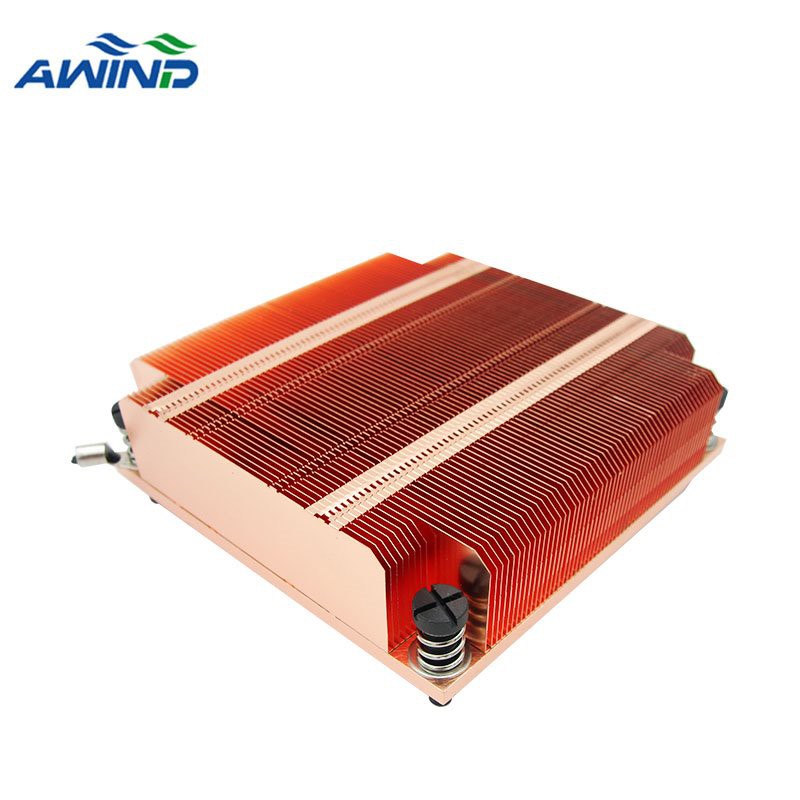
Zippered Fin heat sinks are an ideal air cooled solution for high powered forced convection applications for mass production. A zipper fin stack is constructed from a series of individual sheet metal fins that are stamped, folded, and zipped together using interlocking features. Fin lengths and gaps within a stack can vary by using different stamping dies.
Each zippered fin heat sinks has its own design for progressive perforating fins.This makes the application of the zippered fin assembly more specific, as any new zipper fin heat sink structure usually requires a new set of punching machine. Zipper fin heat sink are ideal for high-volume applications rather than low volume production runs, as stamping costs will be spread over fewer heat sink.

Process Type: Zipper fin heatsink | |
Item | Process Parameter limit |
Fin height | No limit |
Fin thickness | 0.2~2.0mm |
Fin width | No limit |
Fin Pitch | Min 1.0mm, 4X Fin Thickness at least |
Common Used Material | AL 1100, AL 1050, Copper 1100 |
Zipper fin manufacturing process
Zipper fin is used for the processing process of combining the single thin fin formed by stamping AL1050&CU1100 into a dense parallel fin. The specific method is as follows: when forming, a small section of specially designed protruding part (buckle point) is retained at the edge of the fin. The fin is fixed in a customized mold, and the protruding part is bent and locked together to form parallel fins in neat arrangement.
Another purpose of the use of zipper fin is to compensate for the interface impedance resulting from the subsequent connection (usually brazed) between the fin and the heat-absorbing bottom.The connection area between the thin parallel sheet fin and the heat-absorbing base is small, and considering the actual connection rate and interface impedance of the connection surface, the heat transfer between the heat-absorbing base and the fin may become the bottleneck in the entire heat conduction path of the heat sink.
Therefore, the blade folding process will leave a folding edge on the side where the fin will be connected with the heat-absorbing bottom. After bending the lock, the blade will be combined into a relatively flat surface, that is, each fin will have a "wider" bottom, and the side will become an "L" shape. In this way, heat is transferred from the heat-absorbing base to the "bottom" of the individual fin through the connection surface, and from the inside to the vertical part where the heat is actually lost.

Zipper fins heat sinks materials
The benefit of having two separate components is that you can mix and match materials.The zipper fin heat sink material can be copper base and aluminum fins, or copper fin and aluminum base.
Depending on the application requirements, zipper fin heat sink material may need an all-aluminum or all-copper. The material determines the joining between the fin and the base. Aluminum resists soldering, so the aluminum/aluminum joints are epoxy bonded. Epoxy does not adhere well to copper, so copper/copper joints are easy to weld. If mixed the two, the aluminum components are usually nickel-plated and then the assembly is soldered together.

How to identify a stamped fin heat sink?
A Stamped Fin heatsink can usually be identified by the zipper fin plates that hold the fins in place, and it is usually very easy to see that the heatsink is two parts - the base, and stamped fin.
Benefits
1. Simple mechanical locking structure, fewer procedures
2. The interface impedance generated by the subsequent connection between the fin and the heat-absorbing base can be compensated
3. Process quality is relatively stable, suitable for mass production.
4. Thin fins similar to the folded fin heatsinks, but more suitable for fan-sink application than folded fin heatsinks because the top of zipper fin heatsink is open.
5. Copper and aluminum fins are available.

Design Innovation
Our zipper fin heat sinks are highly appreciated by most clients for their lighter weight and high level of design flexibility. It allows our engineer team to design cohesive solutions with heat pipes or fans to meet your specific application requirements.
Application
Zipper fin heat sinks have advantages such as increasing cooling area while forming a closed passage at the same time so as to achieve higher thermal performance via our technical innovations, no restriction on its volume, higher strength, lower manufacturing cost, easier installation and maintenance, longer service life etc.
So it is widely used in data communications, telecommunications, new energy design and military cooling components.

What is the difference between skived and zipper fins?
As zipper fins are joined together on both the top and bottom of the fins, they offer higher mechanical stability compared to other fin types such as skived or folded fins.
In recent years, our High Density Zippered Fin Heat Sinks with OEM/ODM Supplier is of stable quality, rapidly expanding production and steadily increasing market share. We abide by the core values of serious work and innovative ideas, and continue to refine and strengthen our main business. We adhere to the strategic idea of win-win situation with our employees and strive to create a good environment for them.
Hot Tags: zippered fin heat sinks, China, suppliers, manufacturers, factory, customized, free sample, made in China, Heat Sink with Copper Heat Pipe, High Quality Cooling Heat Sink, Skived Fin Heat Sink, Aluminum Extruded Heatsink for Motor, Zipper Fin Heat Sink, CPU Heat Sink Design
[[ProKeywords]]