


Understanding PCBA and Its Cooling Solutions
Awind Hardware Limited
What is PCBA?
PCBA stands for Printed Circuit Board Assembly. It refers to a complete circuit board after all the electronic components-such as resistors, capacitors, ICs, and connectors-are soldered onto the bare PCB.
PCBA is the "brain" of almost every modern electronic device, from smartphones and LED lighting to industrial controllers, medical equipment, and automotive systems.
Why is Cooling Important in PCBA?
As PCBA handles power conversion, signal processing, and data computation, it inevitably generates heat. If this heat is not managed properly, it can lead to:
1. Reduced performance – Electronic components may slow down under high temperatures.
2. Shorter lifespan – Heat accelerates material aging and solder joint fatigue.
3. System failure – Overheating can cause shutdowns or even permanent damage.
That's why effective thermal management-whether through air cooling or liquid cooling-is a critical part of PCBA design.
Common Heat Sink Technologies for PCBA

Extruded Heat Sink
Process: Aluminum extrusion forms a one-piece heat sink with fins.
Features: Low cost, fast production, flexible fin height designs, suitable for mass production.
Applications: Medium- and low-power PCBAs such as power modules and control boards.
Aluminum Base + Integrated Stamped Heat Sink
Process: Combines aluminum heat structures with a PCB or aluminum substrate, often using die-casting or machining reinforcement ribs.
Features: Compact structure, ideal for space-limited designs.
Applications: LED driver boards, lighting PCBAs, amplifier modules.


Skived Fin Heat Sink
Process: A blade tool "skives" high-density, thin fins directly from a block of aluminum or copper, with no solder joints between fins.
Features: High cooling efficiency, low thermal resistance.
Applications: Power modules, inverters for industrial or medical equipment.
Heat Pipe Assisted Heat Sink
Process: Heat pipes transfer heat rapidly from the heat source to the fin area.
Features: Suitable for concentrated heat sources where large heat sinks cannot be installed.
Applications: High-density servers, GPU cards, embedded industrial boards.

Water Cooling Solutions for PCBA
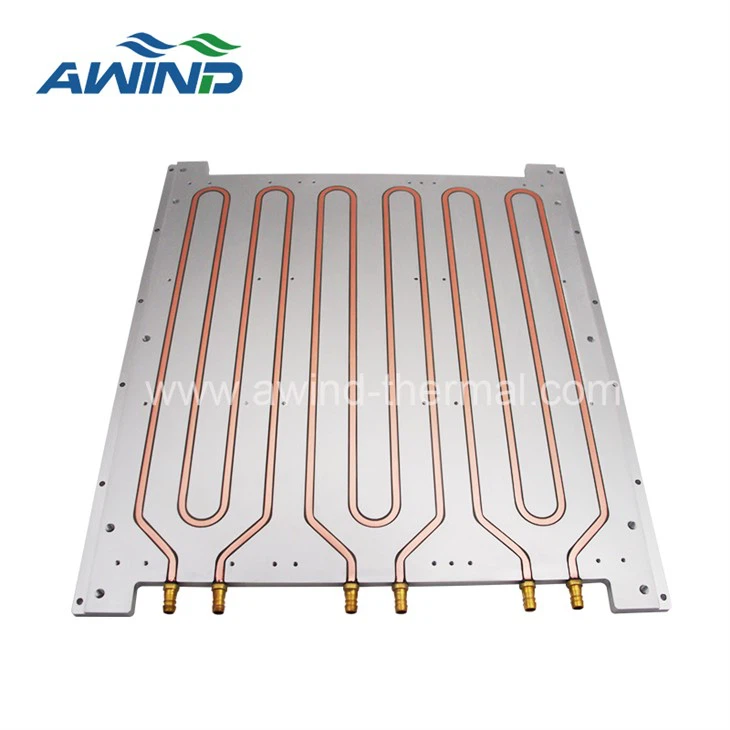
Tubing-Embedded Cold Plate
Process: Copper or stainless-steel tubes (U-shaped or serpentine) are embedded into an aluminum plate.
Pros: Simple structure, low cost, suitable for large-area heat sources or multiple chips.
Cons: Limited contact area, less ideal for precise spot cooling.
Applications: High-power drive modules, power supply PCBAs.
Friction Stir Welded (FSW) Cold Plate
Process: Two aluminum plates are welded together using friction stir welding to form internal channels.
Pros: High structural strength, excellent sealing, eco-friendly.
Cons: Limited design flexibility, restricted to certain materials.
Applications: Inverters, railway systems, servers, telecom base stations.


Vacuum Brazed Cold Plate
Process: CNC machining creates coolant channels, which are sealed with a cover plate and brazed in a vacuum furnace.
Pros: Flexible water channel design, smooth appearance, high precision, scalable production.
Cons: Higher cost, lower structural strength compared to FSW.
Applications: Power electronics, industrial automation, electric vehicles, energy storage, aerospace.
Conclusion
PCBA cooling is not a one-size-fits-all solution.
For moderate heat loads, air-cooled heat sinks such as extrusion or skived fins are cost-effective and reliable.
For high-power, high-density applications, liquid-cooled cold plates offer superior performance.
Choosing the right cooling method depends on factors like power density, space constraints, cost, and product lifecycle.
With proper thermal management, a PCBA can operate efficiently, last longer, and maintain optimal performance-even under demanding conditions.
Hot Tags: understanding pcba and its cooling solutions, China, suppliers, manufacturers, factory, customized, free sample, made in China, Aluminum Cold Plates for Battery, Industrial Water Cooling Cold Plate, FSW Liquid Cooling Plate


