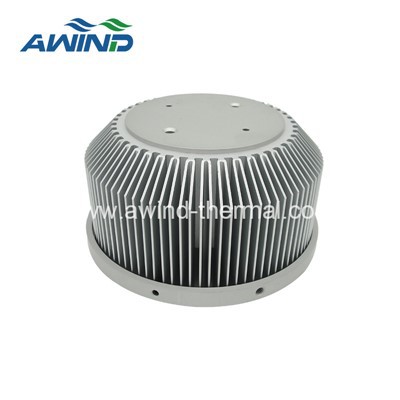
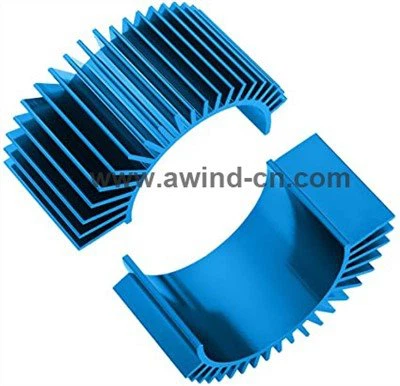
Aluminum Extruded Heat Sink Enclosure For Inverters
Inverters enclosure that operate in summer have a relatively high temperature, which can make them feel too hot to touch. So is it better for the inverter casing to be hot or not? And why does the enclosure feel so hot to the touch? Below, we will analyze and provide answers to these two issues in conjunction with inverter cooling.
The components in the inverter have their rated operating temperatures. If the inverter has poor heat dissipation performance, as the inverter continues to operate the heat of the components and cannot be transferred to the outside world, so their temperature will continue to rise. Excessive temperature can reduce the performance and lifespan of components. In order to maintain the working temperature of internal components in the inverter within the rated temperature range and ensure its efficiency and service life, thermal conductive materials are needed to transfer the heat inside the inverter.
From the perspective of thermal conduction, the more balanced the temperature inside and outside of inverter, that mean the closer the temperature of the internal heating components, heat sink, and shell, the better its thermal conductivity.
If the inverter is cold outside and hot inside, it means that the inverter's heat dissipation performance is not excellent. This is similar to the relationship between a thermos and a regular water bottle. A cup containing hot water of the same temperature dissipates heat faster than a thermos cup, and the cup wall is also hotter than that of a thermos cup. This is because there is a vacuum between the inner and outer walls of the thermos cup, without any thermal conductive medium, so the outer wall temperature is low and the internal heat cannot be dissipated, achieving insulation effect; The wall of a regular cup is a single layer, which can effectively transfer internal heat. Therefore, the outer wall becomes hot but cools down faster than a thermos cup.
The heat dissipation principle of the inverter is similar to that of a single-layer cup, which requires the rapid transfer of heat from the internal components of the inverter to achieve the goal of quickly reducing the temperature of the internal components of the inverter, thereby improving the operation and service life of the inverter. As can be seen from the above, good heat dissipation performance is very important for inverters. Below, we will specifically explain the basic principles of inverter heating and heat dissipation.

Inverter heat dissipation and Inverter heat sink
1. In a circuit, active components generate heat whenever current is applied. The main heating components in inverters include: switching transistors (IGBT, MOSfet), magnetic core components (inductors, transformers), etc. Therefore, in order to ensure that the components can operate at their rated temperature, the system's heat dissipation capability is very important.
2. It is inevitable for inverters to generate heat during operation. For example, for a 5KW inverter, the system's heating power is generally about 1.5-2.5% of the total inverter power, and its heat loss is about 75-125W. Therefore, system heat dissipation and cooling are very important. For small household systems, the industry usually uses natural heat dissipation methods.
3. To achieve excellent heat dissipation performance, the following measures can be taken:
① The larger the heat dissipation area, the better the effect. For example, if the heating power of a 5KW inverter is 125W and the maximum heat flux density that can be borne by natural cooling at 60 ℃ is 0.05W/cm2, the heat dissipation area should be at least about 0.25m2. In order to maintain the same volume and increase the surface area of the heat sink, the heat sink surface is designed with multiple fins and increased fin height, which can increases the contact area between the heat sink and the air and is conducive to rapid heat dissipation.
② The enclosure - heat sink is tightly connected, and the inverter shell is made of aluminum alloy, which has good thermal conductivity. Adopting an integral enclosure structure, the heat sink is closely connected to the enclosure through a large area, and the heat of the components can be directly transferred to the aluminum alloy enclosure through the heat sink, forming a heat dissipation path from the device to the heat sink, then to the enclosure, and finally to the air. In addition, the heat from the components can be conducted to the casing through the air inside the inverter, and then dissipated into the external air through the casing. Another heat dissipation path has been formed, from the device to the internal air, then to the casing, and finally to the external air.
Using a non integral shell, there is a need for two connections between the enclosure and the heat sink, and the contact is not tight. Therefore, only the heat sink and a small part of the middle enclosure are involved in heat dissipation, and the upper enclosure does not participate in heat dissipation, resulting in a significant decrease in overall heat dissipation performance.
Adopting an integral enclosure structure, the heat sink is directly and tightly connected to the enclosure, allowing the aluminum alloy enclosure to participate in heat dissipation through two paths. Because it participates more in heat dissipation, the temperature of the inverter shell is relatively high. The advantage of this phenomenon is that the enclosure has good thermal conductivity, which transfers the internal heat of the inverter faster through the shell, thereby reducing the internal temperature of the inverter and the temperature of the components, ensuring a longer service life of the components and the inverter.
Reasons for overheating and hand burning of inverter casing
1. In order to lower the temperature of components better and faster, and ensure a longer service life of components, a design is adopted that tightly contacts the integral enclosure and heat sink, making the enclosure an important component of system heat dissipation. The heat dissipation performance is enhanced, and the enclosure temperature is higher, which is a normal phenomenon of inverter operation.
2. Sensory temperature: The perceived temperature of the human body is around 36 ℃, and there will be a warm sensation; There will be a burning sensation at around 45 ℃; Prolonged exposure at around 50 ℃ may cause a burning sensation; Prolonged exposure at 60 ℃ can cause burns. Due to the need for inverter heat dissipation and the special working environment (direct sunlight outdoors), safety regulations stipulate that the temperature of the inverter housing cannot exceed 70 ℃. In summer, when the external environment temperature is 40 ℃, the housing temperature is generally between 55 ℃ and 60 ℃. Therefore, when people touch the inverter housing, they will feel hot.
Hot Tags: aluminum extruded heat sink enclosure for inverters, China, suppliers, manufacturers, factory, customized, free sample, made in China, Skived Fin Heat Sink, Anodized Heatsink, Copper or Aluminum Heatsink, Heat Sink, Aluminum Extrusion Profiles Heat Sink, Round Aluminum Heatsink for LED