


We realized that we needed to improve not only the quality of Aluminum Cold Plates for Battery, Copper Skived Heat Sink, Vapor Chamber Heatsink, but also our marketing philosophy, and that only by improving both could we create greater success. We have established a quality system for the whole process of product research and development, design, production operation and service. We actively integrate resources, continue to expand product series, and accelerate enterprise development. The company will, as always, adhere to the business philosophy of 'change comes from innovation' and continue to provide the industry with cost-effective products. We hope to achieve high-quality super-regular leap-forward development of the company through innovation-driven, industry-linked and management-driven. We are equipped with a group of professional R & D personnel, forming a good mode of production, learning and research.
Copper vs Aluminum Heatsink: Which Material Is Right for Your Application?
Copper vs Aluminum Heatsink: Quick Summary
| Feature | Copper Heat Sink | Aluminum Heat Sink |
| Thermal Conductivity | Higher | Lower |
| Weight | Heavy | Light |
| Cost | Expensive | Cost-effective |
Copper and aluminum are the two most commonly used materials in modern heatsink design. Both materials are widely applied in electronic cooling solutions, but they differ significantly in thermal conductivity, manufacturability, surface treatment, cost, and application scenarios.
From a thermal perspective, copper heatsinks offer higher thermal conductivity, allowing heat to spread and transfer more quickly from the heat source. Aluminum heatsinks, while having lower thermal conductivity than copper, are much lighter, easier to machine, and more cost-effective for mass production.
In terms of manufacturing, aluminum heatsinks are easier to process using extrusion, CNC machining, or die casting. Aluminum also supports a wide range of surface treatments, with anodizing being the most common, improving corrosion resistance and appearance. Copper heatsinks, on the other hand, are more difficult to machine and are typically treated with anti-oxidation coatings, nickel plating, or zinc plating to prevent surface oxidation.
Cost is another key factor. Copper is significantly more expensive than aluminum, both in raw material price and processing cost. As a result, aluminum heatsinks dominate applications where weight, cost control, and scalability are critical, while copper heatsinks are often used in high-power or space-constrained thermal designs.
Overall, both copper and aluminum heatsinks play essential roles in thermal management, with their selection depending on performance requirements, budget, and application environment.
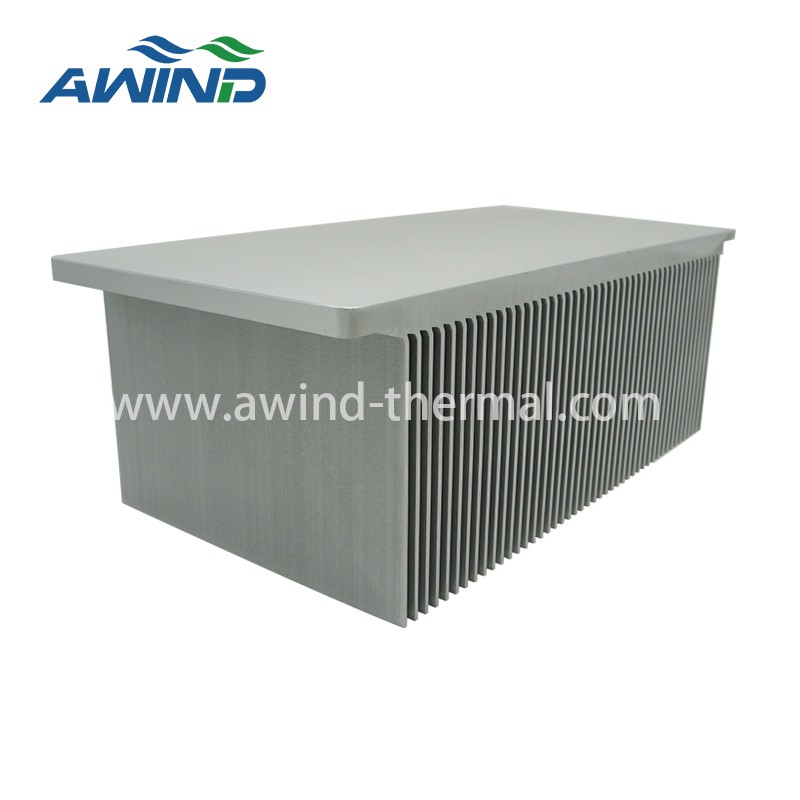
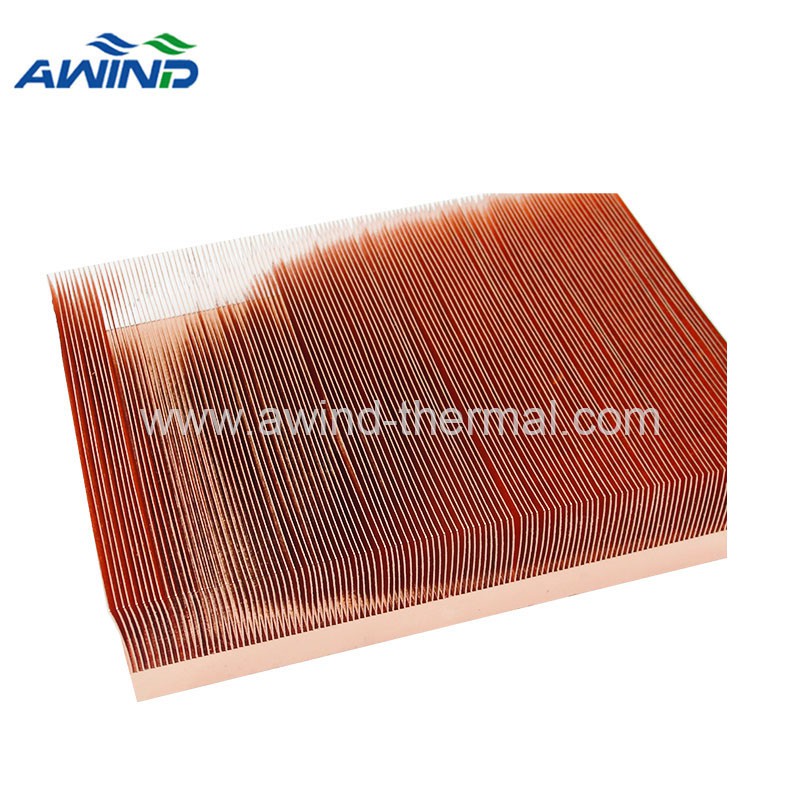
Thermal Performance: Copper vs Aluminum Heatsink
Thermal performance is often the primary consideration when selecting a heatsink material.
Thermal Conductivity Comparison
| Material | Thermal Conductivity (W/m·K) |
|---|---|
| Copper | ~385–400 W/m·K |
| Aluminum | ~200–235 W/m·K |
Copper conducts heat nearly twice as efficiently as aluminum. This makes copper heatsinks highly effective at rapidly transferring heat away from heat sources such as CPUs, power modules, IGBTs, and high-density electronic components.
However, real-world heatsink performance depends on more than just thermal conductivity. Factors such as fin design, airflow, surface area, weight, and overall system cost also play a critical role. Aluminum's lower density allows for larger fin structures without excessive weight, which can significantly improve convective heat dissipation.
In many forced-air or natural-convection cooling applications, a well-designed aluminum heatsink can achieve thermal performance close to that of a copper heatsink, but at a much lower cost.
Choosing the Right Heatsink Material: Differences, Similarities, and Hybrid Solutions
Based on the comparison above, both copper and aluminum have clear advantages as heatsink materials:
Key differences
Copper heatsinks provide faster heat spreading and higher thermal conductivity
Aluminum heatsinks offer lighter weight, easier manufacturing, and lower cost
Common advantages
Both materials deliver reliable thermal performance
Both can be used in passive or active cooling systems
Both support customized heatsink designs for specific applications
If you are unsure which material to choose, it is important to understand that both copper and aluminum heatsinks can achieve effective heat dissipation when properly designed.
For applications that require high thermal efficiency while maintaining cost control, a copper-aluminum hybrid heatsink is often the ideal solution. In this design:
Copper is used at the base to quickly conduct heat away from the heat source
Aluminum fins are used to maximize heat dissipation to the surrounding air
This approach allows each material to play its strengths - copper for rapid heat transfer and aluminum for efficient heat dissipation - achieving optimized thermal performance at a balanced cost.
We specialize in providing custom heatsink solutions, including aluminum heatsinks, copper heatsinks, and copper-aluminum composite heatsinks, tailored to your thermal, mechanical, and budget requirements.

FAQ
Q1: Is a copper heatsink always better than an aluminum heatsink?
Not necessarily. While copper has higher thermal conductivity, aluminum heatsinks can achieve comparable cooling performance through optimized fin design and airflow management. In many applications, aluminum heatsinks provide the best balance between performance, weight, and cost.
Q2: When should I choose a copper-aluminum composite heatsink?
A copper-aluminum composite heatsink is ideal when you need high thermal performance but want to control material and manufacturing costs. This solution is commonly used in high-power electronics, CPUs, power supplies, and industrial equipment where efficient heat transfer and cost optimization are both critical.
Q3: How much more expensive is a copper heatsink compared to aluminum?
Copper heatsinks can cost 2–4 times more than aluminum heatsinks, depending on material thickness, design complexity, and surface treatment. In addition to higher raw material prices, copper also incurs higher machining and finishing costs.
We have achieved rapid development in recent years, established a scientific and technological service team full of innovation ability to continuously promote the upgrading of Industrial IGBT Aluminum and Copper Heatsink and application technologies. While the company continues to grow, we still refuse to give back to the society and devote ourselves to social welfare activities. With perfect equipment and high quality products, our products are sold all over the world.
Hot Tags: Copper vs Aluminum Heat Sink: Cost, Performance & How to Choose, China, suppliers, manufacturers, factory, customized, free sample, made in China, Aluminum Cold Plates for Battery, Heat Pipe Heat Sink, Bonded Heat Sink, Aluminum Extruded Heatsink for Motor, Cooling Plate Heat Sinks, Zippered Fin Heat Sinks
[[ProKeywords]]


