Over the years, we have established a good reputation in the industry of Aluminum Cold Plates for Battery, Zipper Fin Heat Sink, Water Cold Plate Heat Sink with innovative R&D technology, more efficient manufacturing capabilities and rigorous and pragmatic customer service. We adhere to the tenet of "contract spirit, multi-party collaboration, quality first, lean and efficient", and follow the development trend of the Internet era to integrate and optimize vertical resources in a reasonable and orderly manner. The time gives the development space, the science and technology gives the growth strength, our company pursues the highest quality unceasingly and never gives up, provides the first-class product and the service for you.
Aluminum extruded heatsink
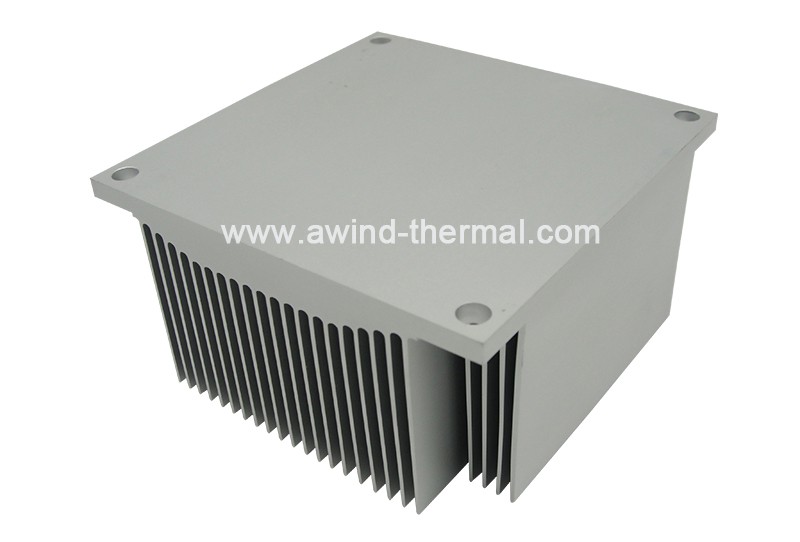
Aluminum extruded profiles heat sinks is also known as heat sink extrusion or extruded aluminum profiles heat sink.
Aluminum extrusion heat sink technology is to heat aluminum ingots to 520~540℃ at high temperature, under high pressure to let the aluminum liquid flow through the heat sink extrusion mold with grooves, to make the extruded heat sink material. Then, after cutting the heat sink extrusion material, the extruded aluminum heat sink we often see is made.
Aluminum extrusion heat sink technology is easy to realize, and the cost of equipment is relatively low, so it has been widely used in the low-end market in previous years.

Item | Process Parameter limit |
Extrusion profile width | Max. 800mm |
Fin thickness | Min. 0.6mm |
Aluminum extrusion density ratio (Fin Height/Fins Gap) | <=20 |
Common Used Material | AL 6063, AL6061, AL6082, |

Why aluminum is the best choice for heat sink material ?
Firstly, thermal conductivity is the most important performance in the choice of heat sink material, and different materials have different thermal conductivity.
The heatsink materials can be diamond, silver, copper, aluminum, steel, etc. You can see their thermal conductivity accordingly as follows:
Material | Thermal conductivity = k = W /(m k) |
Diamond | 1300~2400 |
Sliver | 429 |
Copper | 401 |
Gold | 317 |
Aluminum | 240 |
Iron | 84~90 |
Obviously, the diamond has excellent thermal conductivity. Diamond does not conduct electricity and electrons cannot move freely, so its thermal conductivity basically comes from the propagation of carbon atom vibrations (that is, phonons).
Due to the small mass of carbon atoms and the strong carbon-carbon bond, the propagation of vibration in the diamond is very smooth. Because of this, the thermal conductivity of diamond is very excellent, almost the highest, and almost 5 times that of silver.
Diamond not only has ultra-high thermal conductivity but also it's excellent mechanical, optical, acoustic, electrical, and chemical properties, which makes it significantly superior to other materials in terms of heat dissipation of high-power optoelectronic devices.
Of course, the cost of the diamond is extremely expensive, which makes it not the preferred material for ordinary heatsink products.
The metal with the best heat dissipation is silver, but it is very soft, which is not conducive to manufacturing high-density devices such as heat sinks.
As a precious metal, gold is not a suitable heatsink material because of its expensive cost. The lowest cost material is iron, but its thermal conductivity is only one-third of that of aluminum, which is not the mainstream heatsink material.
These factors have led to the current use of copper or aluminum as mainstream heatsink materials.
Copper has better thermal conductivity than aluminum. However, when considering thermal conductivity, the cost is another factor that cannot be ignored. The thermal conductivity of copper is twice that of aluminum, but its density is three times that of aluminum. This means that the weight of a heat sink that provides similar heat flow in copper will increase by about 50%.
Actually, many copper heat sinks are overweight beyond design limits on weight. When calculating the cost per ton (copper is currently about 3.5 times the cost of aluminum), and you will find that the cost of copper will be much higher than that of aluminum solutions for the same heat sink design.

Which Aluminum Alloy Should You Use for Your Heat Sinks?
The thermal conductivity of pure aluminum is 237 W/m•K, but pure aluminum is relatively soft in mechanical properties, so alloy aluminum is usually used as the heatsink material.
Most of us will first consider using series with high thermal conductivity, such as 1050 aluminum, which offers a thermal conductivity value of 229 W/m•K. However, this alloy is mechanically too soft for heat sinks.
The best choice is 6000 series alloys for heat sinks. These alloys are widely available, are fairly strong, and tend to extrude well. The following chart shows a comparison.
Alloy | Thermal Conductivity Values (W/m•K) |
1050 | 229 |
6061 | 166 |
6063 | 201 |
Alloys like 6061 and 6063 are some of the most common in the 6000 series. They are common for extrusion in general. And either one will actually work quite well for heat sinks.
Feature:
1. More efficient than stamping heat sink
2. More cost saving than mechanical processing
3. There are a variety of standard shapes and sizes
4. Easily customized than copper lighter, obvious advantages
What parameters do you need to select the right extruded heat sink?
Thermal modeling: Thermal modeling will help you choose the heat sink with the performance you need. You can use computer software or ask your vendor for modeling.
Material: Heat sinks can be made of aluminum alloys. The material should have high thermal conductivity. Aluminum alloys are most commonly used as they are durable and have good thermal properties.
Fins: Fins can come in different arrangement, shape, size and location. Each arrangement can influence the performance of the heat sink. For instance, flared pins provide a bigger surface area for heat to dissipate.
Fin efficiency: Fins take the heat from the device and transfer it to air or fluid. You can increase the efficiency of fins in many ways. For example, you can increase the aspect ratio or reduce the length of the fins.

We are a high-tech enterprise dedicated to the industry of 40*35*40 CNC Aluminum Extrusion Radiator Heat Sink Aluminum Profile and have a complete and scientific quality management system. We take innovation as the fundamental driving force to promote the development of enterprises and win customers all over the world with integrity as the greatest wisdom. We guarantee to treat all our customers equally, and provide our customers with same working quality and service standard.
Hot Tags: aluminum extrusion profiles heat sink, China, suppliers, manufacturers, factory, customized, free sample, made in China, FSW Liquid Cooling Plate, Liquid Cold Plate for Power Supply, Zippered Fin Heat Sinks, Cold Forged Heat Sink, CPU Heat Sink Design, Folded Fin Heat Sink
[[ProKeywords]]