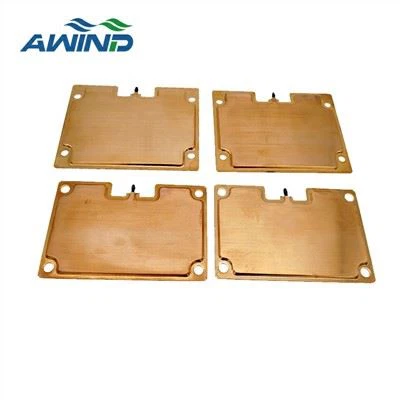
Heat sink for LED
With the continuous development of LED technology, LED lighting products have received more and more attention.
Compared with traditional lighting sources, LED lighting sources are solid-state cold light lamps, which have the advantages of long service life, high luminous efficacy, no radiation, less power consumption, good shock and vibration resistance, and higher safety. Today, when green lighting is generally advocated all over the world, LED has been widely favored as an emerging green lighting source.
However, LED lighting products are prone to overheating during use, especially some high-power LED lighting products have serious heating problems. LEDs are high temperature sensitive components. If they generate a lot of heat and the temperature is too high, it will directly affect the lighting effect, light color temperature, etc. And even have a serious impact on the normal use of LED lighting products.

01 The effect of high temperature on the performance of LED lighting products
Heat dissipation is an important performance that LED lighting products must have. In real life, LED lighting products are often used in different environments, which also has a great impact on the efficiency of LED lighting products. In order to enhance the heat dissipation capability of LED lighting products, it is necessary to study the effect of high temperature on the performance of LED lighting products.
1.1 High temperature causes permanent damage to LEDs
Considering the working characteristics of the LED, if the working temperature is higher than the maximum temperature that the LED can carry, the luminous efficacy of the LED will drop rapidly, and a strong light decay will be formed, which will lead to the damage of the LED. LEDs are mostly encapsulated with transparent polysulfone/epoxy resin. If the pyrolysis temperature is higher than the transition temperature of the solid content (usually 15 °C), the sealing material will transform to a colloidal state, and the thermal expansion coefficient will rise sharply, which will cause the LED of open circuit and damage.
1.2 High temperature will shorten the life of LED
Different brands of LEDs have different light decay characteristics. LED manufacturers generally provide standard light decay curves as a basis for selecting LED products. The life of an LED is closely related to its light decay. The longer it is used, the lower the illuminance of the LED will be until it finally goes out. Generally, the life of the LED is defined as the time when the luminous flux of the LED decays by 30%. High temperature will cause LED light decay and shorten the life of LED.
(1) The defects existing in the LED chip will expand rapidly at high ambient temperature until they invade the light-emitting area, resulting in a large number of non-radiative recombination centers, which greatly affects the luminous efficiency of the LED. In a high-heat environment, micro-defects in the material and fast-spreading impurities from the interface and the board will also be introduced into the light-emitting region, forming a large number of deep energy levels, thereby accelerating the light decay of the LED device.
(2) When the temperature is high, the transparent conductive epoxy resin material will denature and turn yellow, which will seriously damage its light transmission performance.
(3) The light decay of phosphors is also a major factor affecting the light decay of LEDs, and the decay of phosphors at high temperatures is very strong.
1.3 High temperature will affect the luminous effect of LED
Some parameters of the LED constituent materials will change with the ambient temperature, which will cause changes in the parameters of the LED device and directly affect the light output of the LED. In general, the process of decreasing luminous flux with increasing temperature is reversible. When the ambient temperature returns to the initial temperature, the luminous flux will have a recovery increase. This is because when the temperature returns to the initial state, the internal parameters of the LED element no longer change, and the light output of the LED can return to the initial state value. The luminous flux of an LED is divided into cold lumens and hot lumens, which represent the light output of the LED at room temperature and an ambient temperature, respectively.
The specific reasons why high temperature affects the luminous effect of LEDs are as follows:
(1) As the ambient temperature increases, the concentration of electrons and holes in LED lighting products will increase, but the electron mobility will decrease due to the reduction of the forbidden band width.
(2) As the ambient temperature increases, the probability of recombination of the electrons in the potential well and the radiation in the holes will be greatly reduced, forming non-radiative recombination, thereby reducing the internal quantum efficiency of the LED.
(3) The rise of the ambient temperature will shift the blue light peak of the LED to the long-wave direction, resulting in the mismatch between the emission wavelength of the LED and the excitation wavelength of the phosphor, resulting in a decrease in the extraction efficiency of the external light by the LED.
(4) As the ambient temperature increases, the quantum efficiency of the phosphor decreases and the light output decreases.
(5) The performance of silica gel is greatly affected by temperature. As the working temperature increases, the thermal stress inside the silica gel increases, and the refractive index of the silica gel decreases, which directly affects the light efficiency of the LED.

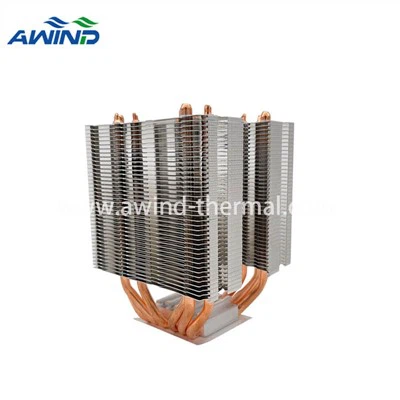
(aluminum skiving fins heatsink)
02 Heat dissipation problems of LED lighting products
LED lighting products generally have heat dissipation problems. In contrast, although incandescent and fluorescent lamps have large power losses, these lamps can be directly irradiated by ultraviolet light, and the heat source of the light source is very small. In the energy consumed by LED lighting products, in addition to the part converted into visible light sources, other energy sources are converted into heat.
In addition, the small size of the LED package makes it difficult to dissipate heat by convection and radiation, thus accumulating a large amount of heat.
2.1 Thermal expansion causes bending and cracking of parts
LED lighting products are composed of many parts, and the materials of various parts are different, and the extent of thermal expansion and contraction is also different. During thermal expansion, component materials will bend and crack, resulting in poor product heat dissipation and seriously reducing the use efficiency of LED products.
2.2 Operational obstacles of electronic circuits
If the working temperature of the conductor components increases, the impedance of the power supply will decrease, and it is easy to enter a vicious circle of "temperature rise - impedance reduction - voltage rise - thermal enhancement - temperature rise", and even burn out.
2.3 High temperature leads to deterioration of material quality
Generally speaking, the metal materials used in LED lighting products are easy to be oxidized, and the higher the temperature, the faster the oxidation rate. High temperature oxidation can shorten the life of LED lighting products.

03 Influencing factors of heat dissipation performance of LED lighting products
3.1 Influence of wind direction on heat dissipation performance of LED lighting products
The researchers conducted experiments on the effect of wind direction on the heat dissipation of LED lighting products. Generally speaking, in the real-world simulation environment, there are three types of wind directions: horizontal right, vertical upward and vertical downward, and the maximum wind speed will not exceed 1.50 m/s. During the experiment, it is necessary to ensure that the LED lighting products used by different groups are exactly the same, except for the different wind directions, all other variables must remain unchanged. During the experiment, pay attention to measuring the temperature of the LED lighting product and calculate the heat dissipation rate of the LED lighting product under different winds. Through experiments, it is found that in the process of heat dissipation of LED lighting products, it is greatly affected by vertical wind. This is mainly because the vertical downward wind direction is opposite to the natural air convection direction, which changes the maximum temperature of LED lighting products.
3.2 Influence of wind speed on heat dissipation performance of LED lighting products
In order to understand the effect of wind speed on the heat dissipation performance of LED lighting products, the researchers also conducted experiments. In the experiment, it is necessary to ensure that the external environment is consistent, and then gradually increase the wind speed. When the wind direction is vertically downward and the wind speed is small, the maximum temperature of the LED lighting product is higher; as the wind speed increases, the temperature of the LED lighting product will gradually decrease.
04 Heat dissipation optimization countermeasures for LED lighting products
When designing the heat dissipation structure of LED lighting products, the fewer the number of structural layers, the thinner the thickness of the layer, the larger the volume of the layer, the greater the thermal conductivity of the material, and the better the heat dissipation. In addition, the shape of the lamp needs to choose a rectangular block or a ring. The heat dissipation design of LED lighting products must follow the design principle of passive heat sinks and active heat sinks as a supplement, and minimize or eliminate active heat dissipation methods.
4.1 Reasonable selection of heat sink
When packaging LEDs, there is no direct connection to heat sinks or electric fans, and the power circuit boards of LEDs generate a lot of heat, which makes the cooling and heat dissipation of LED lighting products a very difficult problem. In this regard, a reasonable selection of heat sinks is required. The heat sink can expand the mutual contact area between the surface of the LED lighting product and the indoor air, thereby improving the cooling and heat dissipation efficiency of the LED lighting product.
4.1.1 Selection of Fins
Typically, the outer surface of the heat sink is machined into fins. There are many types of fins, and the number, position, specification, inclination angle and thickness of the fins must be carefully selected according to the needs. In addition to the ordinary linear shape, the fins also have wavy, spiral, oblong and frustum-shaped shapes. The manufacturing purpose of each shape is to facilitate indoor air convection, rainwater flushing, etc. to obtain the best heat dissipation effect. .
Manufacturers mainly use sintering and grooved production methods to produce heat sinks. Sintered heat pipes of the same specification have the same performance as grooved heat pipes. Among them, when the heat pipe is sintered, a large amount of copper powder will be used as the filler, resulting in a small capillary diameter of the heat pipe and a small penetration power. When the width of the sintered heat pipe increases, the heat conduction effect of the heat pipe will be weakened. Therefore, it is necessary to select the appropriate fins and heat pipes for use. For example, as a very typical LED lighting device, heat dissipation methods such as heat pipe plus fins, vapor chamber heat pipe plus fins, etc. are used in the use of LED street lights to improve the heat dissipation efficiency of the street lights.
4.1.2 Material selection
Among the materials of the heat sink, the thermal conductivity of copper is better than that of aluminum, but the heat dissipation speed of copper is slower than that of aluminum. Therefore, a new copper-aluminum composite heat sink can be used by combining the advantages of copper and aluminum. In the copper-aluminum composite heat sink, copper can quickly bring the high heat generated by the LED to the aluminum, and then the high heat is dissipated by the aluminum alloy fins, thereby improving the heat dissipation efficiency.
4.1.3 Selection of heat sink tubes
The heat sink tube is an important part of the heat sink. When the heating end of the heat sink is just heated, the water near the tube wall will instantly vaporize, forming a large amount of water vapor, which increases the pressure of this part. The water vapor will move to the cooling end driven by the water pressure. When the vapor flow reaches the cooling end, it condenses into a liquid state, releases a large amount of heat energy, and then reaches the transpiration heating end through capillary force to complete a cycle.
For some LED lighting products with high energy consumption and high requirements on heat sinks, metal heat pipes can be selected as heat sink tubes. LED lighting products will generate a lot of heat when working, and when the heat is transmitted inside the LED lighting products, it will be directly transferred to the metal heat pipe through the heat sink. Because the metal heat pipe is heated, no heat is lost during heat transfer. Heat energy can be generated inside the condensation section of the heat pipe, and the heat energy can be transported to the inside of the heat pipe and gradually transferred to the metal material dispersing sheet through the heat conduction effect. The heat energy can be dissipated from the metallic material dispersing sheet through the natural thermal propagation process of the dispersing sheet and the surrounding cooling air.
4.2 Reasonable design of radiator
In the actual radiator design, the combination of external radiator and lamp housing and the combination of built-in radiator and temperature-controlled fan are generally adopted. The heat generated by the LED device can be moved to the integrated circuit board through the sealed leads, and then dissipated through the heat sink; the heat energy generated by the power circuit board can be directly dispersed to the outside through the heat sink through the air and filling materials around the integrated circuit board. In order to eliminate the factors affecting the heat transfer efficiency in the heat transfer path, a material with better thermal conductivity can be used in the heat transfer path, the cross-sectional volume of the path can be increased, or a thermal conductive lubricant can be applied, so that there are no gaps in the joints of the products. If the cooling fins are not able to dissipate the heat to the outside, a lot of heat can build up inside the LED device. In this regard, it is necessary to take measures to optimize the surface structure of the cooling fins. A typical method is to install more fins on the surface to increase the heat dissipation area of the radiator.
4.3 Select the packaging process according to the actual situation
The internal heat generated by the LED can be transmitted to the metal circuit board through the adhesive layer, and then transmitted from the circuit board to the heat sink through the adhesive layer, and then radiated to the surrounding environment. The sealing process, bonding material, and substrate material are the key points of LED heat dissipation design. The heat energy generated by the LED needs to be transferred to the Si substrate through the connection layer, and then transferred to the metal support base through the Si substrate and the bonding material. The structure needs to have good electrical and thermal properties.
4.4 Choose the right bonding material
In order to improve the heat dissipation capacity of LED lighting products, it is necessary to select suitable bonding materials and do a good job in the basic design of LED lighting products. Generally speaking, LED lighting products will use adhesive materials, and the adhesive materials will be affected by the external temperature and humidity. With the continuous development of science and technology, people have also improved the adhesion materials. When designing LED lighting products, you can choose suitable bonding materials according to the actual situation of the lighting products, improve the thermal conductivity and electrical conductivity of the bonding materials, simplify its internal structure, and improve the heat dissipation capacity of LED lighting products.
05 Conclusion
With the development of science and technology, in order to solve the problem of heat dissipation of LED lighting products, it is necessary to select suitable construction materials such as metal heat pipes according to the actual situation. When using LED lighting products, users should not only pay attention to the heat dissipation performance of the products, but also pay attention to the influence of environmental factors on the heat dissipation of LED lighting products.
Hot Tags: aluminum skiving fins heatsinks for led lighting, China, suppliers, manufacturers, factory, customized, free sample, made in China, Copper Skived Heat Sink