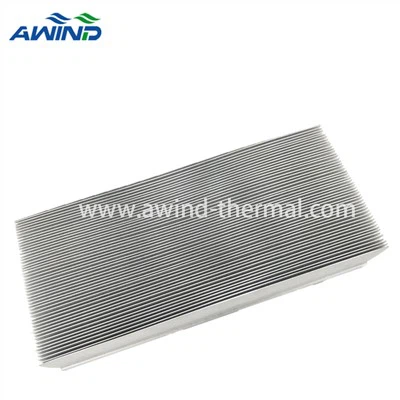
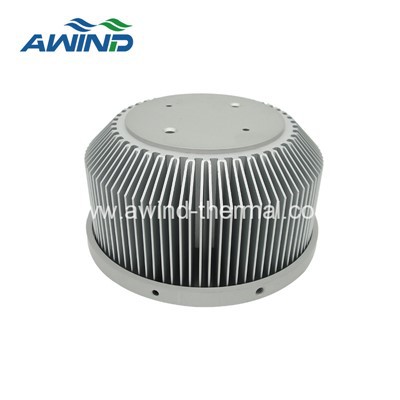
Bonding Heat Sink Heatsink
Bonded fin heat sinks is a different molding method compared to the molding process of extruded heatsink, stamped fins welded heatsink, and other heatsinks. It is to insert the fins one by one onto the substrate, thereby transferring basic heat to the fins.
The following is a typical product case of bonding fins heat sink. We can clearly see that in copper or aluminum, there are evenly spaced grooves, and the heat dissipation fins are inserted into these grooves one by one.

What are the types of bonding fins heat sinks? What are their Advantages and disadvantages?
According to the connection method between the fins and the substrate, it can be divided into the following types:
1> Welding type: The fins and substrate are connected together through solder welding, with high-temperature brazing and low-temperature solder paste welding;
Welding has good heat transfer performance; Welding aluminum substrate and heat sink with solder paste requires nickel plating first, which is costly and not suitable for large-sized heat sinks;
Brazing does not require nickel plating, but the welding cost is still high.
2> Riveting type: After the fin is inserted into the basic groove, the groove is pressed towards the middle through the mold, tightly gripping the fin to achieve a tight and firm connection.
The advantage of riveting is good heat transfer performance, but after repeated use, there is a risk of gaps and looseness in riveted products;
The riveting process can be improved to increase reliability, but the cost will also increase accordingly. Therefore, riveted bonding fins radiators are commonly used in situations where reliability is not high.
3> Adhesive type: Generally, thermal conductive epoxy resin is used to tightly bond the fins and substrate to achieve heat conduction.
The adhesive type uses thermal conductive epoxy resin, which has a much lower thermal conductivity compared to welding, but is suitable for heat sinks with high fins.
The production process of bonded fins radiator
Step 1: Make aluminum/copper substrate and fins according to the design, and slot the substrate. The shape and fit tolerance of the groove may vary depending on the connection method.

Step 2: Splice the heat sink fins and substrate into a whole (welding or bonding can be used according to design requirements)

Step 3: After fixing the substrate and heat sink, subsequent drilling, tapping, and milling of various features on the fins can be carried out. Finally, corresponding surface treatment can be carried out to make the finished product of the bonded fin heat sink.

The Application of Insert fins heat sink
The initial emergence of bonding heat sinks was to address the issue of different materials for fins and substrates, as well as the difficulty of forming high, dense, and thin heat sinks in other ways.
But with the development of technology, many plug-in radiators have been replaced by the skiving fins process.
Whether it is pre grooving, riveting, or welding, the process of bonded fin radiator is relatively complex and costly; And the skivied fins can achieve thinner, higher, and smaller spacing fins than the bonding, and the fins are basically an integral part, with excellent heat transfer performance and simple processing technology. It can also solve problems with different materials (such as using copper aluminum composite plates).
As a forming process for heat sinks, bonded heatsinks still have irreplaceable advantages in certain scenarios or special design situations. For example, we need to insert the expansion plate group into the water cooling substrate, or insert the ultra-thin vapor chamber into the water cooling substrate, or insert the heat pipe into the copper substrate. In fact, we are all using the bonding fins process.
conclusion
There is no distinction between good and bad technology, and the most suitable and cost-effective one for a product is a good technology.


Hot Tags: aluminum bonding heat sink heatsink manufacturers, China, suppliers, manufacturers, factory, customized, free sample, made in China, Bonded Fin Heat Sinks Assemblies