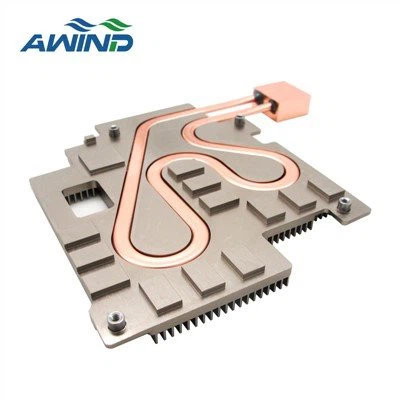
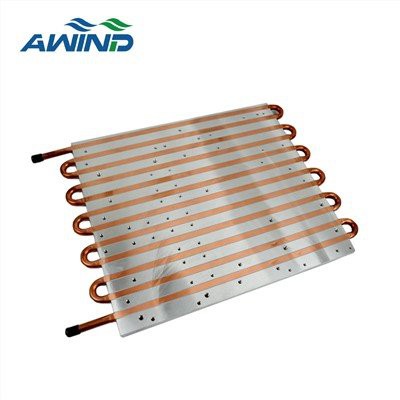
Our quality Bonded Fin Heat Sinks Assemblies, OEM Heat Sink, Liquid Cold Plate for Power Supply and attentive service help increase sales and enhance our corporate image. We create conditions to discover talents, cultivate talents, attract talents and retain talents. Let people with real talent become the main force of the company's development. We create a first-class brand, a rationalized, institutionalized, and humane work environment, create maximum profits to share with employees, shareholders, and customers, and continue to develop and sustain our business.
The heat dissipation effect of vapor chamber in the LED
The main problem of high-power LED is "heat"

According to the testing report of Cree XLamp XR-E, Lower LED temperature can increase its lifetime and luminous flux.
The data of 40mil (1 mm²) LED chip
1W chip: heat flux close to 100W/CM²
3W chip: heat flux close to 300W/CM²
From the above test report and data, we can know that the problem of led heat is mainly high heat density (hot spot) overheating, rather than total heat flux.
Overheating focus on the hot spot, it will affect the lifetime and luminous flux of the LED.
How to solve the problem of the heat focus on the hot spot? We found that high-efficiency heat spreaders can quickly diffuse heat, thereby avoiding the heat from being focus on the hot spots. And the vapor chamber is a kind of heat diffuser that can take away the heat extremely quickly. Its working principle is similar to the heat pipe.
The working principle of vapor chamber
The vapor chamber is a vacuum chamber with a columnar structure inner, usually made of copper.
When the heat is transferred from the heat source to the evaporation zone, the cooling liquid in the chamber begins to vaporize after being heated in a low vacuum environment. At this time, it absorbs heat energy and expands rapidly, and the cooling in the gas quickly fills the entire chamber. When the gas working contact with a relatively cold area, it will condense. The heat accumulated during evaporation is released by the phenomenon of condensation, and the condensed cooling liquid will return to the evaporation heat source through the capillary channel of the microstructure, and this operation will be repeated in the chamber.


According to the working principle of the vapor chamber, we know that:
1. The vapor chamber is a two-dimensional heat conduction product, which can theoretically conduct a large amount of heat in a two-dimensional flat plate.
2. The vapor chamber can be used for lighting modules.
A: Simple geometric structure-the geometric shapes are generally square and round
B: The surface is not easily deformed-the vapor chamber has a tolerance of up to 0.2 mm.
C: When the heatsink is sufficient, there will be less temperature difference-when the heatsink dissipate the heat, the temperature change will be very small.
D: Vapor chamber can only solve the problem of heat transfer, as its heat transfer speed is very fast, but it still need to add an aluminum heatsink to achieve the heat dissipation.
The Contrast Experiment
Experiment 1-Place the LED on a aluminum heatsink, lighting for 10 minutes and then blow it with a DC fan for 5 minutes.

(Aluminum heatsink)
Experiment 2-Place the LED on a vapor chamber and aluminum heatsink, lighting for 10 minutes and then blow it with a DC fan for 5 minutes.

(Vapor chamber on the aluminum heatsink)
12W LED

Infrared experiment 1 results (only use aluminum heatsink)
1-1 : 58 ℃,1-2 : 29 ℃,1-3 : 28.2℃

Infrared experiment 2 results (vapor chamber + aluminum heatsink)
2-1 : 55.2 ℃,2-2 : 31.2 ℃,2-3 : 29.2 ℃
Experiment summary:
The surface temperature of experiment 2 is 3 ℃ lower than experiment 1.
The vapor chamber enhances the heat transfer effect of the LED.
10W thermal resistance

Infrared experiment 1 results (only use aluminum heatsink)
1-1 : 80.4 ℃ 1-2 : 57.6 ℃ 1-3 : 55.5℃
Infrared experiment 2 results (vapor chamber + aluminum heatsink)
2-1 : 67.1 ℃ 2-2 : 57.6 ℃ 2-3 : 56.2℃
Experiment summary:
The surface temperature of the chip in experiment 2 was lower than that in experiment 1 13.3℃. The vapor chamber did enhance the heat conduction of the chip and reduce the thermal resistance.
10W instant thermal resistance

Infrared experiment 1 results (only use aluminum heatsink)
1-1: 29.5℃ 1-2 :30.0 ℃ 1-3 : 30.1℃
Infrared experiment 2 results (vapor chamber + aluminum heatsink)
2-1 : 31.5 ℃ 2-2 :32.2℃ 2-3 : 32.2℃
Experiment summary:
Experiment 2 using a vapor chamber is significantly better than experiment 1 in terms of chip temperature, and maintains a temperature change of 13-15oC for working at 1-10 minutes. This means that the use of vapor chamber can reduce the thermal resistance between the chip and heatsink , can reduce the temperature of junction temperature under the same power-on condition.
Experimental conclusion: the vapor chamber enhances the thermal conduction of the chip and reduces the thermal resistance
How to apply an vapor chamber on high-power LED?
Solution A: Multiple LED chips are directly sealed and mounted on vapor chamber

Comparison experiment of high-power LED (50W multi-chip directly soldered to the vapor chamber ) and (50W multi-chip directly soldered to the copper board)

(50W multi-chip directly soldered to the vapor chamber )

(50W multi-chip directly soldered to the copper board)
Experimental data

(channel 0~3: chip temperature channel 4~5: heatsink temperature)
The chip temperature of vapor chamber is 30℃ lower than that of the copper board
Vapor chamber can make the temperature of the LED lower. When the same heatsink is used to dissipate heat, there is a temperature difference of about 30℃.
The vapor chamber can ensure that the temperature of each chip on the board is the same. If the copper plate is used for heat dissipation, the temperature of the center chip will be much higher than the surrounding ones, which will affect the lifetime of the chip.
Advantages of directly soldering LED chips on the vapor chamber:
1. Reduce the junction temperature of the chip and extend the lifetime of the chip
2. Can make the chip more focus, which better for the overall design of the lamp
3. Make high-power multi-chip packaging possible
Solution B: Print the PCB on the vapor chamber, and install the LED on the vapor chamber by SMT (Surface Mount Technology).

Prototype of Cree XRE chip series applied on vapor chamber

Using SMT, the test data of heat dissipation between vapor chamber and aluminum plate


Vapor chamber have more uniform heat dissipation and faster conduction.
Form two tests, we know that:
The vapor chamber can withstand 170℃
Vapor chamber has no limitation of shape
The heat dissipation of vapor chamber is through capillary holes
Thickness of vapor chamber at least 3MM
The vapor chamber MBTF exceeds 86,400 hours.
The vapor chamber can withstand more than 200 thermal shocks from -40℃ to 110℃
Conclusion
Through a series of comparative experiments, it is clear that the vapor chamber significantly improves heat conduction efficiency and effectively reduces thermal resistance in high-power LED applications. Whether used directly beneath multi-chip LED modules or combined with PCB/SMT structures, the vapor chamber consistently lowers junction temperature, minimizes hot-spot concentration, and maintains uniform temperature distribution across the LED surface. These advantages directly translate into longer LED lifetime, higher luminous stability, and greater system reliability.
In addition, the vapor chamber demonstrates strong durability under extreme temperature cycling, supports flexible geometric designs, and maintains excellent flatness and structural stability - making it highly suitable for next-generation high-power LED lighting, automotive lighting, outdoor displays, and other applications requiring high heat-flux management.
At Awind, we have extensive experience in vapor chamber design, manufacturing, and LED thermal module integration. Over the past years, we have developed hundreds of successful vapor-chamber-based solutions, covering LED modules from 50W to 1500W. If you are currently evaluating thermal solutions or seeking to optimize LED heat dissipation performance, feel free to contact us. Our engineering team can provide customized thermal designs, simulations, and samples to help you achieve the most efficient and reliable LED performance.
We have been committed to providing high-quality D40*400mm 350W High Power Heat Column Heat Cylinder for LED Heatsink Can Be Customized, and one-stop value-added services to our customers. Welcome all nice buyers communicate details of products and ideas with us!! Based on the principle of good faith, we have established long-term cooperative relations with many customers. Now we are further strengthening the improvement of the technical level of our employees, injecting high-tech into products, and striving to provide better quality and more affordable products to users at home and abroad.
Hot Tags: Vapor Chamber Basic Knowledge and Performance Test, China, suppliers, manufacturers, factory, customized, free sample, made in China, Aluminum Cold Plates for Battery, Liquid Cooling Plate, Bonded Fin Heat Sinks Assemblies, Anodized Heatsink, High Quality Cooling Heat Sink, FSW Liquid Cooling Plate
[[ProKeywords]]