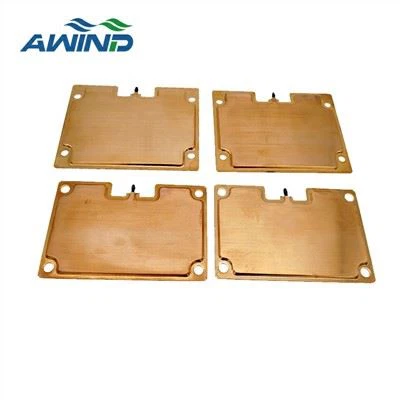
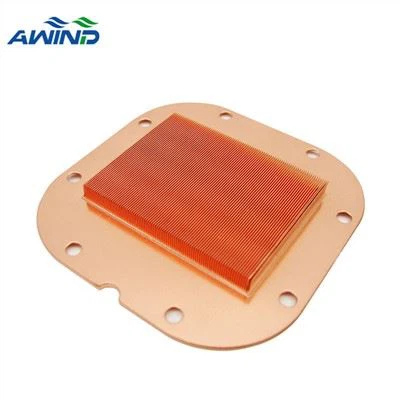
Whether it is the design of Bonded Heat Sink, Aluminum Extrusion Profiles Heat Sink, Cooling Plate Heat Sinks, the choice of materials, or the positioning of the product, we have been carefully planned and won a good reputation. The competition among enterprises is not only a competition in scale, but more importantly, a competition of professional and technical strength between enterprises. We have the domestic leading technology, professional technical team and strong professional equipment strength. We continue to strengthen internal management, establish and improve the supervision and management mechanism. Our employees are loyal and active, closely combining the contribution of their positions with the operational efficiency of the enterprise, and maximizing their personal ideal and the value of the enterprise.
Common heat sink manufacturing technology processes on the market and their characteristic
CNC machining
CNC machining is performed by CNC machining equipment. Because CNC machining is controlled by computer after programming, CNC machining has stable machining quality, high machining accuracy, complex surfaces, and high machining efficiency.
The advantage of the CNC process is that it is widely used.
The disadvantage is that the equipment wears quickly, and most of CNC machining require manual participation or automatic control, which made the cost is high.

CNC machining
(photo by internet)
Aluminum extrusion
Aluminum extrusion is to heat the original aluminum alloy ingot to about 520~540 ° C, and use mechanical pressure to make the aluminum liquid flow through the extrusion die made of die steel, and cool the aluminum liquid at the die outlet to make it rapidly solidified to become the initial embryo of the heat sink with a continuous parallel structure, and then the initial embryo is cut and other processing is aluminum extrusion.
The commonly used aluminum material in this way is AL6063, which has good thermal conductivity (about 160-180W/m*K) and work ability.
The disadvantage of this material that the heat sink of thickness to length of the fins cannot exceed 1:18.

Aluminum extrusion
(photo by internet)
Skiving fins
Skiving fins is to cut a whole piece of metal according to the requirements, use a precisely controlled special planer to cut a sheet of specified thickness, and then bend it up to an upright state to become a cooling fin. This method is most common on pure copper heat sinks.
The advantage of the skiving fins is that base and fins are integrally formed, the connection area, there is no interface impedance, and the fins are thicker, which can make more effective use of the heat dissipation surface area; Get a larger heat dissipation area.
However, this method is affected by raw materials, etc., and the yield is low; the distance between sheets is short, the air passage space is small, which made the wind resistance is large. And production equipment, production costs are very high.

Skiving fins
(photo by internet)
Forging
Make the rural aluminum alloy into liquid, and go into the mud, using pressing machine to press, and freeze it, which is the machining of cold forging.
The advantage of cold forging is no resistance, the fins can be thin or high dense structure, which can made the special design come true.
The disadvantage of cold forging: Cause the life of mud is short and high cost equipment, low productcity which made the cost high.

Cold forging heatsink
Die-casting
After the original aluminum alloy ingot is melted into a liquid state, it is filled into the mold, and is die casted by a die-casting machine at one time. After cooling and subsequent treatment, a single heat sink is made.
The advantages of aluminum die-casting: it is integrally formed, without interface impedance; it can manufacture thin, dense or complex fins, which is easy to realize some special designs.
The disadvantages: the mechanical properties and thermal conductivity of the material cannot be balanced; the surface flow pattern and oxide slag during die casting are too much, which will reduce the heat conduction effect; the internal micro-shrinkage cavity is high during cooling, and the actual thermal conductivity is reduced; the mold life is short, and the equipment Relatively complex, the output is small, which made the cost is slightly higher.
Zipper fins and Welding
The dense and thin heat sinks we have seen are made by this process. When forming, the edge of the fin retains a small section of specially designed protrusions, which are fixed in a custom mold, and the protrusions are bent and interlocked to form neatly arranged parallel fins.
Combined with stamping, it is mainly used to manufacture parallel dense thin fins used in reflow or ducted designs.
The advantages of the folding method are obvious: the mechanical locking structure is simple and the process is few; it can compensate the interface impedance generated by the subsequent connection of the fin and the heat sink. One-time equipment investment can produce a large amount of output. Now many heat pipe cooling products on the market have this kind of fin linking method, which is stable and simple.
At present, most of the heat pipe heatsink, the connection method between the heat pipe and the fin is welding. Because the bonding degree of the welding place directly affects the heat dissipation effect, the cost of welding is relatively high.
 zipper fins heat sink with heat pipe
Our Al6063-T5 Anodized Silver White Color Aluminium Extrusion Heat Sink incorporates years of industry experience and industry application knowledge, thus has a superior performance and stability. We hope to fully mobilize the enthusiasm of enterprise employees and enhance the cohesion and centripetal force of the enterprise. Building the most competitive enterprise is the strategic positioning of our company's development direction and the development goal of the core competitiveness of our products.
Hot Tags: Common heat sink technology and its characteristics , China, suppliers, manufacturers, factory, customized, free sample, made in China, Round Aluminum Heatsink for LED, Vacuum Brazed Liquid CooLED Plates, Copper or Aluminum Heatsink, Liquid Cold Plate for Power Supply, Anodized Heatsink, Vapor Chamber
[[ProKeywords]]