


Our High Quality Cooling Heat Sink, CPU Heat Sink Design, Round Aluminum Heatsink for LED has won the favor of consumers all over the country and abroad with exquisite design, fine production and diversified functions. Our employees contribute their wisdom to the company's advantage in the new competition, and we are proud to have many such employees! The leading quality comes from the advanced manufacturing technology. For this reason, on the one hand, our company does not hesitate to invest a large amount of money in a number of processing centers. Our clients mainly distributed in the international markets.
Heat pipe vs Vapor chamber
When dealing with heat dissipation projects for high-power electronic devices such as CPUs, GPUs, ASICs, or IGBT modules, we are often asked the same question: Should we use heat pipes or vapor chamber? Which of them is better?
There is no standard answer to this question. Both utilize the principle of phase change heat transfer and have very high thermal conductivity, but their roles in heat dissipation schemes are actually very different.
This article mainly shares some of our team's experiences in practical projects, hoping to help you clarify when to use which solution.
Working principle
vapor chamber is responsible for "diffusion" and heat pipes is responsible for "transmission"
If we imagine heat as water flow:
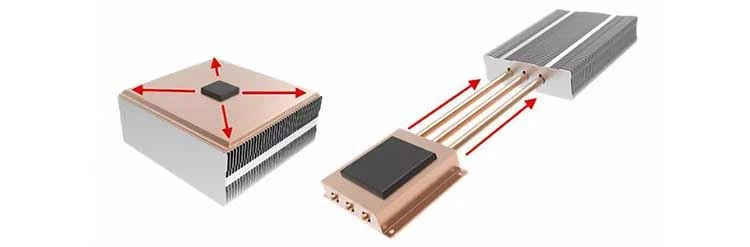
The vapor chamber is like a flat "water pan" - heat comes in from a point source in the middle and quickly spreads across the entire surface, "diluting" the heat at high temperature points.
A heat pipe is like a "water pipe" - it quickly transports heat from point A to point B in the distance, making it suitable for scenarios that require "transfer".
So, which one to choose first depends on whether your heat needs to be 'spread out' or 'sent away'.
Heat treatment method
Vapor chamber: It evenly spreads heat from the surface of the chip to a large area of the bottom plate or fins. Suitable for situations with high power but limited space and insufficient heat dissipation area.
Heat pipe: Heat pipes are used to connect heat sources to distal fins, especially for relatively tortuous paths. Even if the path is straight, more heat pipes will be used instead of VC to remotely transfer heat. This is the key difference between heat pipes and VC radiators, as heat pipes focus on heat transfer.
Applicable power density
Vapor chamber: It is usually ideal to handle heat flux densities above 20W/cm ². We have done cases with heat flux densities above 300W/cm ² and can still effectively control the temperature.
Heat pipe: A single heat pipe can handle tens to hundreds of watts, but if the heat source area is large, multiple pipes often need to be used side by side.
Thickness limit
Temperature equalizing plate: The common sintered core VC thickness is between 2.5 and 4 millimeters, and ultra-thin versions can be made thinner, but the process and cost will increase.
Heat pipe: The diameter of the round pipe is generally 3 to 6 millimeters, and it can be flattened to about 2 millimeters, but the heat transfer capacity will be reduced after flattening.
Handling of multiple heat sources
Vapor chamber: If multiple heating chips are in close proximity, a single VC can cover them simultaneously, achieving overall temperature equalization.
Heat pipe: If the heat sources are dispersed, usually each heat source is individually arranged or multiple heat pipes are connected to the same set of heat dissipation fins.
Cost
Vapor chamber: The larger the size, the higher the cost, especially for large areas of VC exceeding 100 × 100mm, and the processing yield will affect the unit price.
Heat pipe: The cost of standard specification heat pipes is relatively controllable, and customized bending or flattening may increase some costs, but overall it is still cheaper than VC of the same area.
You may have encountered several practical pitfalls in design as well
1. The area of the vapor chamber must be large enough
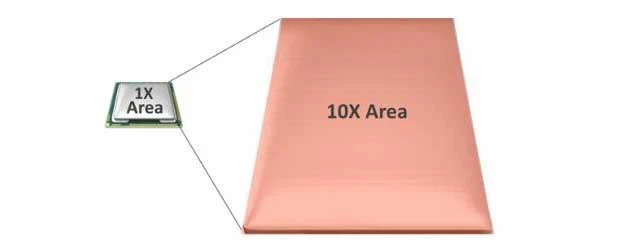
Some customers want to use a VC that is about the same size as the chip to directly attach it to the chip, and then add a fan to blow it on top. The effect of doing so is actually not much different from that of copper blocks. The area of VC should be equal to or greater than 10 times the area of the heat source.
2. The bends of the heat pipe should be minimized as much as possible
Heat pipes can be bent, but with each bend, their heat transfer capacity decreases slightly. If there are multiple bends on the path, the actual heat dissipation effect may only be half or even lower than that of a straight pipe. So try to be as straight as possible. If bending is necessary, the corners should be rounded and the radius of the bend should not be too small.
3. Two technologies can be used together
For some particularly high-power cases, we will combine VC with heat pipes: use VC to directly contact the chip, quickly spread the heat throughout the entire substrate, and then further guide the heat to the large-area fins at the far end through several heat pipes. This combination scheme is common on many server CPU heat sinks.
how should I choose vapor chamber or heat pipe?
If I were to give a simple direction for judgment:
Priority should be given to the case of vapro chamber:
The chip has a high power density (such as 20W/cm ² or more)
Space height is limited, requiring a slim design (3-5mm height)
The chip area is not large, but we hope to quickly spread the heat to the large-area heat sink
I hope the surface temperature of the entire radiator is more uniform and reduces local hotspots
Prioritize the case of heat pipes:
There is a certain distance (such as 50mm or more) between the heat source and the final heat dissipation position
Multiple heat sources distributed in different locations
Cost control is relatively strict
It is acceptable to embed the heat pipe into the aluminum base plate and heat it evenly before transferring heat through the base plate
The combination of the two:
High power density and the need to guide heat to distant locations for heat dissipation
The internal space of the system is irregular, and the heat dissipation path needs to bypass other components
Pursuing ultimate performance with relatively sufficient budget
AWIND often designs such integrated solutions for the following areas:
High end servers
telecommunication base station
Industrial power converter
If you have any ideas in this regard, please feel free to contact us for more information, and we can evaluate your project at any time.
We will continue to adhere to an effective, coordinated, and scientific development policy, and gradually form an industrial structure featuring diversified industries, large-scale development, and professional management, and strive to become the most valuable 5 Heat Pipes Stacked Fin Copper Base Soldering Tec Heat Sink for Automotive company and brand. The company has introduced advanced technology and production lines from abroad to provide the company with stronger market competitiveness for the development of new products. We will follow the tenet of innovation, rigorous and pragmatic and the enterprising spirit of smart quality, striving for perfection to create first-class products and first-class services, so that our business will take off.
Hot Tags: Vapor Chamber vs Heat Pipe: Which Is Better for High-Power Cooling?, China, suppliers, manufacturers, factory, customized, free sample, made in China, Aluminum Cold Plates for Battery, Folded Fin Heat Sink, Liquid Cold Plate, AL Extrusion Heat Sink, Liquid Cold Plate for Power Supply, Water Cold Plate Heat Sink
[[ProKeywords]]


